


 How can a country that, unlike most countries, is supposed to have a “purpose” … but doesn’t know what that purpose actually is ... expect to sing about it?
Archive for the ‘Faith and Works’ Category
Hoping against hope
Posted by Ron Coleman on March 28, 2007
Posted in Faith and Works, Orient | Leave a Comment »
Writing like hell
Posted by Ron Coleman on March 27, 2007
I”ll be damned if I can make heads or tails out of this:
Hell is a place where sinners really do burn in an everlasting fire, and not just a religious symbol designed to galvanise the faithful, Pope Benedict XVI has said.
Addressing a parish gathering in a northern suburb of Rome, the Pope said that in the modern world many people, including some believers, had forgotten that if they failed to “admit blame and promise to sin no more”, they risked “eternal damnation – the inferno”. . . .
He had wanted to reinforce the new Catholic catechism, which holds that hell is a “state of eternal separation from God”, to be understood “symbolically rather than physically”.
Agostino Paravicini Bagliani, a church historian, said the Pope was “right to remind us that hell is not something to be put on one side” as an inconvenient or embarrassing aspect of belief.
Please, I’m sorry. Under Catholic doctrine, hell is to be understood symbolically rather than physically, but is a place where sinners really do burn in an everlasting fire, and not just a religious symbol?
Salvation sought. Dawn?!
UPDATE: St. Dawn the Dutiful takes a break from her book-promotion duties to respond to my email inquiry:
Dear Ron, Good question. I’m not a theologian, but I’d hesitate before accepting a reporter’s parsing of the Pope’s message (re “symbolically”). For one thing, the Pope wasn’t likely speaking in English, plus the context is lost.
The Catechism does not use the word “symbolic” — see here:
http://www.vatican.va/archive/catechism/p123a12.htm#IV
I think what the Pope was saying had to do with the fact that the Catechism does say that hell is a state of self-exclusion from God, so there is not a physical place with a lake of fire — it’s not like, “make a left on Hollywood, a right on Vine, and three doors down to where you smell brimstone.” What actually exists for a soul that refuses to align itself with God after death could in fact be worse than what we would picture as eternal fire, but fire may be the best possible analogy for it. That would be my guess.
Best,
Dawn
Naturally the reporter, or his editor, blew this. It’s important because people love to mock orthodox religious belief, and it helps if that belief is presented incoherently.
Posted in Faith and Works | 12 Comments »
With rabbis like this, who needs Judaism?
Posted by Ron Coleman on March 26, 2007
I wouldn’t expect Newsweek to get anything right about Judaism, and would expect their list of The Top Fifty Rabbis in America to be a joke. . . .
But two of them in the top ten aren’t even from the branches of liberal Judaism. They are leaders of other religions entirely. That is to say, unlike the progressive branches of Reform or Conservative who wrestle to find Jewish meaning (and usually lose) in their negotiations with secularism and liberalism, these two religions represented in the top ten contain specifically foreign theological content.
Number four is Yehuda Berg, of the
cultNew Religion, the Kaballah Centre.And the number one (number ?!?) is Rabbi Marvin Hier, the leading theologian for political Holocaustism.
Ouch! With cuts like that, who needs a mohel?
Posted in Americana, Faith and Works | 2 Comments »
Parshas Vayakhel
Posted by Ron Coleman on March 16, 2007

This week’s Torah portion is Vayakhel:
The Talmud (Tractate Shabbos 108) declares that through Sabbath observance even one who worships idols is forgiven. Why is Sabbath observance, as expressed primarily through refraining from creative acts, so fundamental?
Note: Comments requiring moderation under our guidelines will not be moderated until after the Sabbath!
Posted in Faith and Works | 6 Comments »
The Pope is Catholic. Rudy Giuliani is a politician.
Posted by Ron Coleman on March 13, 2007
 It should not be newsworthy that the Pope insists that Catholics, including politicians, take their faith seriously, not as something for Sunday in the pews but as something that guides their moral choices — even if they are officers in a democracy. But this Pope does have a spine, if much of the Vatican “career staff” that serves him doesn’t.
On the other hand, Allahpundit’s obsession (in the link) with the un-Catholic public policy stands of Rudy Giuliani is not new. I can’t imagine Giuliani even holds himself out as a practicing Catholic except in the most nominal sense, being on his third wife and all, but if I am wrong about this I will say I am not surprised. I expect little from politicians, even those I admire in their roles (not as role models) and support. But while I hesitate to speak for traditional Catholics, I can imagine that they expect, and are happy to get, far more from their religious leaders.
And that is not something to take for granted.
If I thought he were listening, I would advise my old friend Allahpundit not to get too hung up on Giuliani’s departure from the creed. That doesn’t mean he shouldn’t have his feet held to the fire on these issues, and that it isn’t a good idea for conservatives to be the ones to do it — I think we should. I just don’t think there are all that many people left who don’t know that Giuliani has historically been pro-abortion, even though he is actually rather conservative — or makes the conservative move — on many social issues. And after all, the present President was rock-solid on abortion. But even Allah has to admit that, from a conservative point of view, that choice (if you’ll pardon the expression) has not necessarily worked out so well.
That is the problem with single-issue candidates. We’ve all been there — I voted for Clinton in 1992 to punish GHWB for James (“F the Jews”) Baker — and we’ve all been burned. Is that the stake you want to flame out on, Allah? Because I’m not so sure the Church is going to keep you company.
Posted in Faith and Works, O Mores!, Politics and Poker | 13 Comments »
Pure and chaste … from afar
Posted by Ron Coleman on March 11, 2007
Dawn Eden, more than a little interested in the subject, clarifies the word chaste:
[E]veryone is supposed to observe chastity according to their state in life, so there’s single chastity and there’s married chastity. Chastity is really a way to look at all your relationships so that they no longer become mere exchanges of commodities. It’s a plan for your whole life, for your happiness, and for eventually going to heaven. I look at chastity as a way to practice what it’s like to be in heaven.
Huh — live and learn. It reminds me of the Jewish concept of tzeniuth, which is usually translated as “modesty” (typically alluding to modesty in matters of dress) but which I learned really means “dignity.”
 There is one use of the word “chaste,” though, that I will always remember. It was on the old Mary Tyler Moore Show, when Murray Slaughter — the crypto-Jewish copywriter played by Gavin McLeod — his heart filled to bursting, finally has to tell Mary that he’s in love with her. (This was before McLeod became captain of, ironically, the Love Boat.) Mary, perpetually single but very desirable, expresses how flattered she is and gently reminds Murray that he’s married (thus avoiding the more painful truth that he’s not in her league). Murray, the literary romantic, resolves it by assuring her that he knows this, he loves his wife, and that he will still always love Mary (“Myeh-ry” as he says it; the Jewish part of his character is not played out as Rhoda Morgenstern’s is, but with that accent in Minneapolis, and his literary pretensions, it’s pretty clear) “pure and chaste from afar.”
I found that very touching, and of course somewhat sad, but also was impressed by the level of maturity that Murray showed in making this acknowledgment. I must have been impressed — I am sure I saw that episode about 30 years ago, and it still sticks with me. Still and all, the higher service for Murray would have been to keep his feelings to himself — this would truly have been pure and chaste and, especially, “afar.” In Jewish sensibility we call this k’rivath hadaath, literally, “the bringing-close of the mind” — for such a revelation of one’s feelings about another, regardless of acceptance or rejection, opens up new mental gateways between the two people in conversation. The Torah teaches us that merely expressing something verbally, among other things, can cross a line of the heart, breach a wall of emotional propriety that protects far more than mere emotions.
Murray, in fact, pushes the point and cannot restrain himself from asking Mary if the feeling is mutual. Of course, it isn’t. So she kind of says, “I love ya, buddy” and bear hugs him as his aunt might — thereby bursting his bubble — not as if he could ever have dared to think otherwise.
Yes, Murray would have been better nurturing, or neutering, his secret love secretly. I wish I could remember in whose name I saw this bit of doggerel — it went something like this: “Not everything that is said should be written; not everything that is thought, should be said.” Imagine where the blogosphere would be with such a worldview; and yet this golden rule — and not merely whether my swinging fist implodes your visage — is , perhaps, the very minimum guideline of a civilized, i.e., social, person. Perhaps this too it is of a piece with Dawn’s definition of chastity.
Posted in Faith and Works, O Mores! | 16 Comments »
Churchill was right about the Jews
Posted by Ron Coleman on March 10, 2007

Winston Churchill, it turns out, wrote an article in 1937, three years before he started leading Great Britain in which he addressed the wave of anti-Semitism sweeping across Europe and the United States at the time, and which would culminate in the Holocaust. It was withheld from publication — too hot, even for then — even for England. What did the Great Man think was the problem?
The central fact which dominates the relations of Jew and non-Jew is that the Jew is “different.”
He looks different. He thinks differently. He has a different tradition and background. He refuses to be absorbed.
Churchill was right. I agree with everything he says, and so does the Jewish tradition. We may quibble over whether “the Jew” truly “refuses” to be absorbed in a conscious way, or whether instead he cannot be absorbed because he looks, thinks and springs from difference.
In fact Jews have absorbed, millions of them, and to a large extent by choice. In Western Europe alone large portions of the population have Jewish blood coursing through their veins. In America assimilation is a fact. You might also say that the ones who do get absorbed aren’t really Jews any more so they are no longer a “problem.” But the Jews always manage to spring up a stubborn branch of different that indeed will not be absorbed.
That doesn’t justify oppression or prejudice, and Churchill did not, from the excerpt available, attempt to justify it. He just laid it on the line: They’re not like everyone else. To the extent that that gets under peoples’ skin, people are going to lash out. Not because of the difference, though. Because the difference, rather, is a statement that causes resentment. The statement is: We Jews have a special relationship with God.
That riles certain people up. Now, why it does is a good question, since almost every religious group in history, and many national and ethnic groups, have made the same exact claim without getting everybody so angry. William Norman Ewer (not Hillaire Belloc!) wrote:
How odd of God
To choose the Jews
Lots of people understand why it’s not odd. Churchill may not have, but this article doesn’t seem to suggest anything but sympathy, limited by his own class’s attitudes — the suggestion implict, for example, that assimilation would be a good thing. This is an attitude that is as old as the Jews, and certainly beats the alternative. There’s no question that Churchill’s attitude toward the Jews, and Jewish-related questions, was complex (though complexity should not be confused with incoherence) and he was a complex man with a complex set of responsibilities, influences and goals.
But this attitude, and Churchill’s comment, do miss the point: The Jews’ job in this world is to be the Jews.
UPDATE: David Kelsey agrees, down to the choice of picture. Great minds?…
Posted in Faith and Works, Past is prologue | 15 Comments »
Memory hole
Posted by Ron Coleman on March 7, 2007
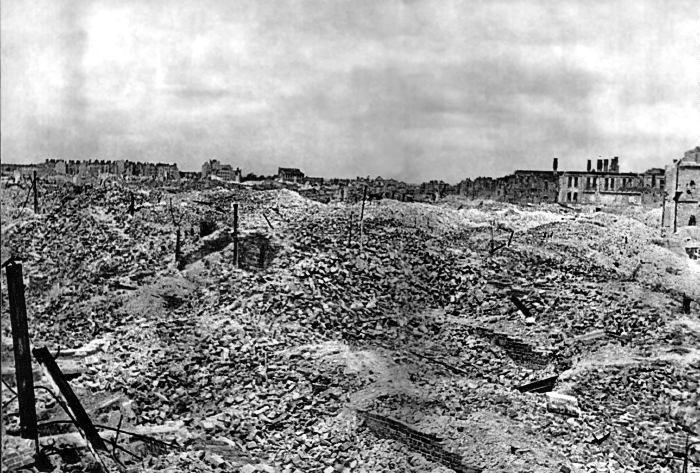 I wrote last month about the opening of the definitive archive of the Holocaust in Germany, called the International Tracing Service, which was featured in this extraordinary report on 60 Minutes. That segment said that the archive was finally, after years of being — for no particularly good reason — closed to the public, going to be opened. But Anne Applebaum, writing in Slate, says that “although commission members are meeting in Holland this week, supposedly to make final arrangements, it’s still far from clear that they will finish the process soon.” She’s naturally upset about that, and rightly so.
There is sense in this world, even when the Hand of God is not so evident, as Jews were reminded last Sunday in celebrating the holiday of Purim. The Book of Esther commemorates that Hidden Hand, describing how a seemingly unconnected series of events and “coincidences” in ancient Persia resulted in salvation of the Jews from yet another plot to destroy them all. To the Jews it is elementary that, through all the Purims of history, Providence directs the events. Sometimes we need the perspective of many years to understand why awful things are perpetrated in this world.
 So once again, in Persia — not ancient Persia, but one which resists modernity with a vengeance — awful events, such as the threat by the national leadership to annihilate the Jews of the region, the staging of a neo-Nazi “Holocaust Conference,” and a bizarre obsession with The Jews — may perhaps act as something of an historical spur to the urgent need to unlock the archives. The purpose is not to bask in Holocaustism (one of the worst religion-replacements Western Jews have yet invented) but to take the cap off the memory hole so truth and horror may be seen, and learned from. If learning is still at all possible.
Posted in Faith and Works, Past is prologue | 5 Comments »
Jihad What?
Posted by Ron Coleman on March 6, 2007
Robert Spencer was nice enough to invite me to write for Jihad Watch, as he recently acknowledged. As he puts it:
Anyway, a good many good writers jumped out of Esmay’s ideological gulag at that point, including Ron Coleman of LikelihoodofConfusion.com (who tells me that he is looking for a “home” for general-interest blogging; I invited him to write here but he politely declined my invitation because he is not primarily focused on the jihad …)
I’m not just unfocused on it. I’m downright befuddled by it.
Believe me, I’m (intellectually, not emotionally) scared of “the Jihad,” or whatever you may want to call the Suicide Belt Boys. I’d be stupid not to be. Dean Esmay does not argue “we have nothing to be afraid of” — far from it. Dean does, however, have his own preferences in terms of nomenclature, which is evidently quite a big deal. Fine. On the other hand, before 9/11 I remember having a perfectly civil, and quite interesting, discussion about GOP outreach to conservative Muslims with Grover Norquist, who by all indications is now pretty much “discredited.” It seemed like a good idea at the time.
On the other hand I don’t know what to make of this article in Jihad Watch on an exchange with Dinesh D’Souza which I thought would clarify everything, but most assuredly does not:
D’SOUZA: One of the problems here is a little bit of paranoia. These guys, Spencer, Serge, have been running around basically saying I am trying to silence them, whereas all I am doing is disagreeing with them.
Caught making an indefensible point, D’Souza lies about it. In his book, this is exactly what he says: “In order to build alliances with traditional Muslims, the right must take three critical steps. First, stop attacking Islam. Conservatives have to cease blaming Islam for the behavior of the radical Muslims. Recently the right has produced a spate of Islamophobic tracts with titles like Islam Unveiled [by Spencer], Sword of the Prophet [by Trifkovic], and The Myth of Islamic Tolerance [by Spencer]. There is probably no better way to repel traditional Muslims, and push them into the radical camp, than to attack their religion and their prophet.”
Okay, so I don’t understand how this is “trying to silence” anyone. Saying “shut up, you’re doing something stupid” is not “trying to silence” someone. (This is trying to silence someone.) It’s telling them — this is rhetoric — “you should not say what you’re saying if you want to come to an accomodation.”
I don’t agree with D’Souza. But I don’t think what he’s saying is what Robert says he is. Now, that also doesn’t mean Robert’s wrong about D’Souza. This — from that same posting — is truly damning:
HENNEN: OK, one at a time here; your question for Dinesh, Serge, is?
TRIFKOVIC: In what order are the Suras arranged in the Kuran?
D’SOUZA: [long silence] I really don’t know what you mean by that. When you say “in what order” then… err… [pause] there…
TRIFKOVIC: … an interlocutor who tries to pass authoritative judgments on the subject is refusing to tell me how are the Suras and the verses of the Kuran arranged. They happen to be arranged by SIZE, from short to long!
Well, that sure seems like something you better know before you write a book about Islam, isn’t it? I think Robert’s got plenty to work with here without stretching about being “silenced” by D’Souza.
But at the end of the day, you can see why I don’t want to make this “my topic.” I’ve gone through about half a dozen tractates of the Talmud from beginning to end and I don’t even really know what’s in them. Forget it. My main reaction to radical Islam is to stay out of its way.
Posted in Faith and Works, Orient | 7 Comments »

