Likelihood of Success

Ron Coleman’s pretty good blog

Archive for the ‘Americana’ Category

CPAC thoughts

Posted by Ron Coleman on February 25, 2010

Not mine, mind you.  I send John Hawkins down to round everything up for me.  If I were to attend in person, the whole mystery persona would be shot!  Look what happens to Ron Paul, for example, when people actually look under that rock.  Yeah, there goes my putsch strategy.  So that’s right out.  But Right Wing News has just released the top 20 quotes from CPAC 2010.  I’m not even saying they’re even all safe for work–they’re not.

That’s the other reason I don’t go to CPAC.  Because I’m the last cultural conservative, remember?

Posted in Americana, Heart and spirit, Politics and Poker, Right Wing to Nowhere | Leave a Comment »

Best of 2009: “At the junction”

Posted by Ron Coleman on December 31, 2009

This was first published on June 24, 2009.

My first reaction when I saw this post on a blog called Infrastructurist (looks very cool) (via Boing Boing) was just to link to it on my Facebook page. I also lament the loss of these great — well, in some cases very large and grandiose, if not necessarily actually great — civic works of sculpture. I come to work, in fact, through the new Penn Station every day, and work in One Penn Plaza (yeah, me and those buildings!), overlooking (actually, straddling) the non-entity of a transport hub that now bears the Pennsylvania Station name as well as the depressing Madison Square Garden.
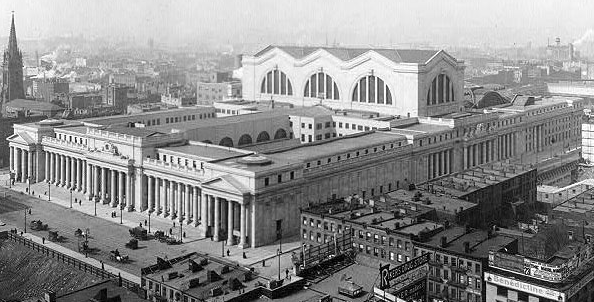
Pennsylvania Station

Then I went ahead and wrote this comment, and decided to recycle and touch it up a little here, for the benefit of my larger other audience.

To a large extent the manner in which the loss of these temples of transit compels so many of us is a testament to what we really think about a world ruled solely by utilitarian concerns. That latter, callous attitude toward the spiritual importance of environment on human existence, in the cities as much as anywhere else, is displayed by Alon Levy in the comments at the original post.

God help us in the soulless, bottom-line libertarian future that so many think they want!

Ironically, the utilitarian worldview is incapable of accounting for the long-term utility and welfare (in the microeconomics sense of the word) that derive from civic pride — the decline of which, from the 1950’s on, along with the decline in the quality of inner city life, surely must be linked to the decline of the humane in urban architecture.

And yet: As the (not so godless?) Alon says in a subsequent comment, “Ron Coleman, you’re the first person I see use the word spirituality to mean ‘preserving train station facades.’” Indeed: Many of these buildings were and are obsolete, and the cost of their respective upkeep, utility expense, restoration or retrofit, relevance to modern transportation need or all of the above would constitute a preposterous budget item for almost any public entity saddled with such costs. Only religious dogma, and perhaps theocracy, could justify such devotion.

Rail transport, despite its highly romantic appeal, is great for everyday commuting but is seldom of the choice of travelers from afar, for whom flying — even in its own diminished state as a culture and a humane experience — is a clearly superior choice. Most other travel remains, in America, highway-based, because Americans want to go where they want, when they want and with whom they want, and they want to get back home that way, too.

In addition, the cheap labor and lax or nonexistent building, fire, safety and access standards of the nineteenth century, which made it possible to erect and use these behemoths, are truly relics of a different age. So who is going to foot the bills to maintain these buildings as obsolete white elephants? Or is someone here volunteering for a special tax assessment so Detroiters can stare at their irrelevant grand terminal?

There’s the facts, Jacks.

I sure wish we had the old Penn Station here, though.

Comments at the original post.

Posted in Americana, Best of the Blog, Heart and spirit, Metropolis, Style | Leave a Comment »

First, let’s all us lawyers kill ourselves

Posted by Ron Coleman on November 29, 2009

This advertising campaign is, well, bad.  Very, very bad.

There is a certain irony, though, you know.

The defense representation being offered here is in fact completely legitimate — n0t only to sleazeballs, slime and creeps, who are constitutionally entitled to their defense (just not by me), but to people involved in all sorts of disputes (but typically divorces) who are wrongfully accused of being sleazeballs, slime and creeps.

But the choices made in these ads completely undermines that bona fide prospective, mainly because in the graphic, hyper-realistic and borderline pornographic pictures, the crimes being referred to are really happening.

Guess what, law firm?  People who have been wrongfully accused of these acts, or who desperately want the world (including the justice system) to believe the accusation is wrong, want to be represented by the lawyers who only have innocent clients.

And from these ads, that does not seem to be you.  Get it?

Turn in your wingtips.  Please.

Cross-posted on Right Wing News.

Posted in Americana, Lex scripta, O Mores! | Leave a Comment »

Cake that!

Posted by Ron Coleman on October 15, 2009

I read this laugh-out-loud (not “LOL,” which, for me at least, almost never involves actual laughter) article in the New York Times about cake-decorating disasters, mostly proving that you can never underestimate some people’s poor taste nor estimate the level of literacy required to work in a bakery.

Much of the joy in following Cake Wrecks comes from Ms. Yates’s wry assessment of every plopped-out flower and bug-eyed snowman. She is particularly savage about punctuation mishaps, like when a baker omitted an exclamation point after the inscription, “Way To Go Bob.” Ms. Yates wrote, “Just try to read this cake without sounding sarcastic. Yeah. Exactly.” Beneath a Father’s Day cake that starkly announced “1 Dad,” the caption read, “Of all the Dads out there, you are one of them.” . . .

“The person had probably called up and said, ‘Can you put Olympic rings on my cake?’ ” Ms. Mattson explained. Instead, the edible red letters read as follows, parenthesis and quotation marks included: (“Olympics Rings”)

I say this as a former cake decorator myself, with several years of high school Carvel ice cream cake artistry very literally under my belt. Thing is, I did finish high school.

Posted in Americana, Jocularity | 2 Comments »

Leben zol Columbus!

Posted by Ron Coleman on October 12, 2009

That’s the refrain of the old Yiddish song celebrating the New World — the land of Columbus (saved from revisionism here).

I had never quite understood why Columbus was named after a city in Ohio.  I mean, the place is pretty much landlocked.  But then I took Spanish and learned what I doofus I was — he was actually named after yogurt!
Or was it he was named after kishkes?

Either way it was evidently better than they had in the Old Country.

Posted in Americana | Leave a Comment »

My September 11th

Posted by Ron Coleman on September 11, 2009

This five-post article was originally posted on Dean’s World.

I work in New York City. That morning I was late on the way into the office. I had to stop off at what was then called the “AT & T Phone Store” to replace my cell phone. I chose the one just off Sixth Avenue in Midtown, near the subway stop before the one I usually got off at. This was around 53rd Street — a good two and a half miles north of the financial district, if you don’t know New York.

It was a very bright, pretty day — I remember noticing this as I got out of the subway. I went into the store and found a clerk, and he was showing me the different models. And then his own cell phone, clipped onto his belt at the hip, rang. He asked me to pardon him, and took the call. Then he hung up and came back to the counter.

“My wife. A plane crashed into the World Trade Center!”

“Oh, gosh,” I said. I thought of the time during World War II when a bomber returning from Europe slammed into the Empire State Building. “What a disaster.” I had taken my family to the observatory at the Twin Towers just a couple of weeks earlier, to look at the whole world from the top of a building. The salesman and I shared a “tsk” and chose a phone, and completed our transaction.

I decided to walk over the Fifth Avenue, where my office was at the time. Two “avenue” blocks, about ten minutes of a walk, into the Rolex Building on 53rd and Fifth.

I went into the entrance on 53rd, through the cool marble lobby, up to the 12th floor, where my office was at the time. The elevator opened into our library, and the receptionist looked up.

“Did you hear?” she asked?

“About the accident at the World Trade Center?” I asked.

“Both buildings — another plane!”

Both buildings?

Another plane?

This was not an accident.

I walked past her to my office overlooking 53rd Street and switched on the radio.

This was something altogether different.

Part two here.

Posted in Americana, Heart and spirit, Metropolis | 1 Comment »

“Moore” is less

Posted by Ron Coleman on September 9, 2009

A softer view on Ted Kennedy, though not entirely different from mine on the facts — merely on the politics — from my former professor, Sean Wilentz:

[Kennedy] overcame personal flaws and searing travails to become a masterful legislator, congressional infighter, and builder of unlikely coalitions. Ironically, he achieved all of this only after he had surmounted the political entitlement that made his career possible in the first place. In an even deeper irony, of the three famous and powerful Kennedy brothers, it was youngest brother, Teddy the latecomer, who arguably had the greatest impact on American politics and government. These travails and these ironies gave Kennedy’s life dimensions of American triumph as well as of prideful, classical tragedy.

When Kennedy first ran for the Senate in 1962, at the age of thirty, for the seat that JFK vacated when he was elected president, the rap against him was that if his name were Edward Moore [instead of Edward Moore Kennedy] his candidacy would be a political joke. It was true, of course: Although he was hardly a reluctant candidate, he was very much the dutiful, slightly wayward, much younger brother in what some viewed warily as a family that was busily acquiring a new firm, otherwise known as the federal government of the United States. As the assistant district attorney for Suffolk County three years out of law school, Kennedy’s surname was really all he had going for him, and everybody knew as much–but that name, and the presumptions about the politics and connections that went with it, were magic in Massachusetts. . . .  Never again, through eight re-election campaigns, would Kennedy fail to win less than 55 percent of the vote. . . .

For many years, he did not understand how the incident at Chappaquiddick in July 1969 foreclosed the possibility that he would ever succeed JFK to the presidency or fulfill the promise of RFK’s presidential campaign in 1968. In part, this was because he would never be able to explain his actions and inactions of that night adequately (except, perhaps, to the forgiving voters of Massachusetts). But the events also marked the beginning of what would become a convergence of celebrity scandal mongering and cynical prurience that forever changed the rules of American political journalism–and from which Kennedy, with his personal demons, would not escape for decades.

Read the whole thing; Sean is a pretty fair broker, and was probably right when he wagged his finger at the the House of Representatives during the Clinton impeachment.  I still believe that, even from the perspective of a liberal, Kennedy does not merit the special treatment of internment in a privileged spot at Arlington.  And Wilentz asserts the same thing above that my cousin Brian G. does in the Facebook comments to my previous post –“it was youngest brother, Teddy the latecomer, who arguably had the greatest impact on American politics and government” — and goes further than Brian in at least suggesting at least half of the answer why that could be, he does not demonstrate it; it’s probably a comparison of apples and oranges, anyway, but if given the chance I would welcome the opportunity to debate the question with someone willing to take the “Teddy” side of it.

Hat tip to The Browser.

Posted in Americana, Heart and spirit | 3 Comments »

The wrong thing: Kennedy in Arlington

Posted by Ron Coleman on August 27, 2009

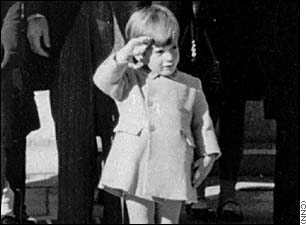
jfkjrsalute

The third time as farce

I felt a little bad writing a fairly vicious piece about Ted Kennedy that I posted pretty much at the cusp of his stay in this world.  But then I considered that, seeing as how he was so sick, he probably would not read it.  So I did not kill him.

What kills me right now, though, is that while there is nothing to be said for speaking ill of the dead, there is plenty to say about the very ill idea, which sounds like all but a done deal, to bury him in Arlington National Cemetery.

This is astonishing, and it is so wrong, that we do have to speak.

Ted Kennedy’s two years as a buck private in the Army were spent far, far from harm’s way — and there was plenty of harm to be had, in a place called Korea.  He technically qualifies for Arlington (both as a veteran and a member of the Senate), which despite running out of space is still open for business.  But he is not merely going into a private’s grave or even a Senator’s :  He is being buried alongside his assassinated brothers, a former President, Senator and war hero and a former Attorney General, bona fide presidential candidate and Senator, murdered by politically motivated killers for what they stood for.

And what did Ted Kennedy stand for?

Right, he just died.  I’m not writing that piece.

But his burial alongside John and Robert Kennedy vastly demeans their memories, and is an uncomfortable reminder of the heavy thread — well, call it a chain — of political fixing and nepotism that characterized the entire sad Kennedy saga.

Jack and Bobby were not perfect politicians, leaders or men by any stretch of the imagination, but in the scheme of things, they arguably rose to the level of opportunity their father bought for them.

I know this because I read about in books.  I was child when each of them was killed.  But to paraphrase Lloyd Benson, we all knew Ted Kennedy, and he’s no Jack Kennedy… or Bobby.

Notwithstanding his legendary personal charm and “effectiveness” in the Senate, and not even considering his worst crime, Ted Kennedy was merely the undistinguished scion of a very wealthy, powerful family. He not only achieved virtually nothing on his own merit prior to his preposterious placement into the Senate, but had already been shown to lack the basic sort of ethical standards that would have, in that time, disqualified anyone else for high public office.  Nonetheless he spent a gin-soaked lifetime raising the taxes and controlling the lives of those less privileged than himself, assured of life and, as it turns out, death in that exalted office by virtue of representing a constituency besotted by a family name burnished by his more accomplished and “martyred” older brothers.

Edward Kennedy’s internment alongside those brothers is a tawdry reminder of the stain of corrupt nepotism and elitism that will demean what had, despite those dubious origins of the Kennedy legacy, become a hallowed place in American civic religion.  It is the wrong thing, yes, but in fact it is probably, at the end of the day, entirely right.

UPDATE: There are comments here, too.

Posted in Americana, O Mores!, Politics and Poker | 2 Comments »

Look in the mirror!

Posted by Ron Coleman on August 23, 2009

Glenn Reynolds cites Matt Welch, to the effect that “The Real Reason Americans Are Angry: It’s The Big Government, Stupid“:

It’s been a hilarious August, watching media supporters of President Obama’s health care package puzzle over the obscure motivations of the noncompliant Americans rallying against it. . . .

While the commentariat’s condescension is almost comical, the whole evil-or-stupid explanation misses the elephant in Obama’s room: Americans of all stripes, it turns out, aren’t very keen about the government barging into their lives. . . . This isn’t about liberal or conservative, Democrat or Republican. A majority oppose Obama’s policies because they fly in the face of this country’s bedrock values of personal liberty and limited government. . . .

Then, gentlemen, who are these angry people angry at?

THESE ANGRY PEOPLE ELECTED A COMPLETELY BIG-GOVERNMENT GOVERNMENT.  This “majority” elected Obama and two parliamentary houses full of whores (or worse) while being under no illusions whatsoever as to what “Obama’s policies” were going to be.

Either this is a “different majority” or someone is playing three-card monte here — can we have two 51 percents in the same whole?

We get the democracy we deserve when we vote for it.

And, by the way:  I wonder how many members of this majority sat at home (0r worse) because John McCain’s conservativism wasn’t pure enough for them, and helped us arrive at this state of affairs?

And now these “Americans” are “angry” at Obama — for being Obama?!

Posted in Americana, Oppression, Past is prologue, Sisyphus | 1 Comment »

The other side of the Prince of Darkness

Posted by Ron Coleman on August 18, 2009

JTA:

Robert Novak, the conservative columnist whose scoops broke many a career, made his reputation as a journalist by being unafraid to attack his ideological brethren.

The same dynamic underlay the contentious and at times ugly relationship he had with fellow Jews.

The article then goes on to cite when would appear to be rather tepid examples of this “ugliness,” which frankly did not compel me.  Being critical of Israel is not ugly, when it is intellectually honest.  I didn’t see, in their presumably well culled selection, any particular demonstration of dishonesty or “ugliness” — which is not to say that Novak didn’t have  a bias, and a point of view, about Israel and its Jews that were influenced by factors other than his famed fearlessness in calling a spade a spade.  This would put him in the category of 98% of humanity.  But he was no Pat Buchanan.

So was one of those “factors” his conversion to Catholicism?:

He cooperated in 2003 with the Washingtonian magazine in a feature about his conversion to Roman Catholicism five years earlier, and said that although he joined a Jewish fraternity in college, he was turned off by Judaism.

“I found the same thing in Judaism as a young boy as I did later in the Unitarian Church and then at the Episcopal Church,” he said. “They seemed very ungodly. The clergymen seemed very secular.”

Following his conversion, U.S. Sen. Daniel Patrick Moynihan (D-N.Y.) reportedly quipped,  “Well, we’ve now made Bob a Catholic. The question is, can we make him a Christian?”

Hm.  Someone say “ugly”?  Now, Moynihan himself was, of course, a Catholic (of sorts), and if he hadn’t been you might take that the wrong way (you might not know this, but many evangelicals and other Protestants don’t consider Catholics “Christians”).  But this remark could also be taken another wrong way — namely that Novak, once a Jew, will always be a Jew.   Again, Moynihan was not only not an anti-semite, he was a philosemite.  So that’s not what he meant.  Not exactly.  But clearly there’s something about the pushy, annoying, dialectically-minded Jew that is peeking out here, and his embodiment of this classic, well, archetype surely haunted Novak.

Taken as a whole, though, the story here is one of a good-hearted if intense person with a strong and independent moral sense, an inclination toward conservative values and sensibilities, and a wish for a meaningful and demanding relationship with God.  A lot of Jews, especially talented ones, fit this description.  Some find their way back to their heritage; some are so turned off by the watered-down “ungodly” clergy and “religion” of liberal Judaism that it is only repellent to them and seek a link to a greater whole, to spirituality and to transcendence elsewhere — sometimes cults, and sometimes established brands such as Buddhism, socialism or Catholicism. Read the rest of this entry »

Posted in Americana, Heart and spirit | 1 Comment »