Likelihood of Success

Ron Coleman’s pretty good blog

Archive for the ‘Lex scripta’ Category

Trust us, we’re from the government

Posted by Ron Coleman on December 13, 2007

Ilya Somin:

When the Supreme Court upheld the condemnation of private property for transfer to other private parties in Kelo v. City of New London, it was in large part on the theory that courts should defer to local governments’ judgments about when the use of eminent domain is needed to promote “economic development.” However, two and one half years after the Supreme Court ruled in favor of the city and some seven years after the condemnation proceedings were first initiated, little or no economic development has occurred on the condemned land.

You’d almost say it’s enough to make anyone a small-L libertarian, except the fact is the Supreme Court booted this under plain old constitutional law.

Posted in Gelt, Lex scripta, Sisyphus | 2 Comments »

“They killed my husband”

Posted by Ron Coleman on December 12, 2007

Above The Law reprints a bizarre obituary evidently written by the widow of a lawyer, who believes his partners killed him by overwork.

Posted in Americana, Gelt, Lex scripta | 5 Comments »

The federal judge to pull if you’re a “terrorist”

Posted by Ron Coleman on December 10, 2007

Above The Law quotes an email from the Hon. Matthew Kennelly of the Northern District of Illinois regarding a local rule requiring the lowering of a flag when a serviceman or woman residing in the court’s jurisdiction is killed in the line of duty:

Matthew Kennelly/ILND/07/USCOURTS
12/10/2007 10:40 AM

To: Annette Panter
cc: ILNDml_Eastern Division
Re: Fw: Amendment to U.S. Flag Code, Public Law 110-41

Not to be flip about it, but since we appear to be in a war-without-end against “terrorism” (or “terror,” as the Pres. ungramatically [sic] puts it), we may well never see another flag at full-staff in our lifetimes.

“Terrorism,” see — in scare quotes.

Defendants:  Next time you’re shopping for a grammatically savvy “judge” in your “terrorism” case, do what you can to pull Judge Kennelly.  Brought to you by President Bill Clinton.

Posted in Americana, Lex scripta | 1 Comment »

Deep competence

Posted by Ron Coleman on December 4, 2007

Here’s what it looks like when people really — really — know what they’re talking about.  On both sides of an issue.  In this case, the issue is Guantanamo.

(Via Glenn.)

Posted in Lex scripta | Leave a Comment »

Big shoe drops

Posted by Ron Coleman on November 20, 2007

On the Second Amendment.  Evidently, what was a stupid, unsupportable decision to this New York judge is of some interest to a few Supreme Court justices.  They might agree with him. Or not.

Posted in Americana, Lex scripta | Leave a Comment »

Their day in court

Posted by Ron Coleman on November 19, 2007

Dahlia Lithwick writes perceptively about how critical it is that litigants — especially in family court — feel they have been heard by the court:

Last week in Las Vegas, Reno, Nev., millionaire Darren Mack shocked the court by pleading guilty, midtrial, to killing his estranged wife, Charla, in June 2006. . . . In the weeks before he murdered Charla, Darren Mack was frustrated and then enraged by Judge Weller’s interim custody and support order, which resulted in shared physical custody and the requirement that Darren pay Charla $10,000 per month in interim spousal support. Darren didn’t pay, Weller found him in contempt, and Darren declared bankruptcy. Convinced that Weller “had made up his mind prior to coming to court, … didn’t like him and no matter what he did, Weller would rule against him,” as a friend explained, Darren launched a crusade. . . .

Mazoltuv Borukhova was outraged by the Oct. 3 decision of Sidney F. Strauss, a state Supreme Court judge in Queens, to transfer temporary primary custody to Malakov, evidently without a hearing. Even if a judicial move like this sounds familiar—courtesy of the Britney Spears 24-hour legal cable extravaganza—it’s almost never done. Judge Strauss, however, switched custody because Borukhova “was allegedly not cooperating with supervised visitation.” . . .

I’ve come to suspect . . . that Mack may have snapped because, after years of feeling listened-to in the family courts, even when he lost, he came across a judge who seemed to reach swift conclusions, without always hearing him out.

After he pleaded guilty last week, Mack went out of his way to thank Judge Herndon, saying he appreciated the “integrity” the judge had shown throughout the murder trial. There is much that needs fixing in the family law system. But, at least from the perspective of these two aggrieved parents, the quickest fix seems to be a family court judge who schedules one more conference, and presides over one more hearing, and truly listens, even when she thinks she’s heard it all before.

These complaints are in the air all day if you are involved, as I am, with litigation matters that implicate anyone but the largest corporations. They’re especially pernicious in family court, where the judges are required to get involved in situations full of raw emotion and to issue rulings that are almost certain to inflame more.

But in almost any case, Lithwick is right: Nothing — nothing — outrages litigants as much as the perception that the judge isn’t listening, has already made up his mind, and isn’t fair. Thus I have found that many settlements, objectively unreachable, have been achievable when a judge, or even a court-appointed referee or other neutral, spends “quality time” in his or her chambers at a judicial settlement conference. It is ideal if both sides will agree to a period where each litigant can have the judge to him- or herself.

All of a sudden it turns out that, quite often, it really isn’t “about the money,” when a person feels he has had his day, however brief, “in court.” It says something about our litigation system, and about the arrogation of power by the government through the courts, that this is so often impossible to achieve. A large part of the complication comes from the increasing criminalization of almost every aspect of the family law system in the states, as extensively written about by bloggers such as Trudy Schuett.

It would be awful to contemplate that judges might start listening to these stories because it’s dangerous for them not to.

Cross-posted at Right Wing News.

Posted in Americana, Lex scripta, Oppression | 4 Comments »

Bad lawyer. Bad.

Posted by Ron Coleman on November 15, 2007

Thanatopsis - Asher B. Durand

TaxProf Blog quotes the Seventh Circuit once again whaling on a hapless lawyer:

Jerold W. Barringer represented Patridge at trial, in the Tax Court, and during the three appeals to this court. He has performed below the standard of a pro se litigant; we have serious doubt about his fitness to practice law. The problem is not simply his inability to distinguish between plausible and preposterous arguments. It is his disdain for the norms of legal practice (19 issues indeed!) and the rules of procedure. . . .

Here is the complete text of his “STATEMENT OF THE FACTS” . . . . This contains not a single fact and verges on illiteracy. . . .

We therefore give Barringer 14 days to show cause why he should not be fined $10,000 for his frivolous arguments and noncompliance with the Rules, and why he should not be suspended from practice until he demonstrates an ability to litigate an appeal competently and responsibly.

Just this kind of day for me. Hat tip to Above the Law.

Posted in Lex scripta, Sisyphus | Leave a Comment »

A dying practice

Posted by Ron Coleman on November 13, 2007

Dahlia Lithwick exposes the dirty little secret of capital punishment in this country:  It’s dying a death by a thousand injections.

As Richard Dieter at the Death Penalty Information Center points out, once the Supreme Court granted certiorari in Baze, the states were forced to defend their protocols en masse, even if they knew them to be flawed. If even one state were to change its procedure now, prisoners in the other states would have a constitutional claim. It’s a form of—pardon the pun—prisoner’s dilemma; the states backed their way into a rotten system, and now they must insist that it’s the greatest, most constitutional system around.

But Dieter points to another, more important reason states aren’t racing to embrace new execution methods: “The pitched battle over the death penalty is not a rational one,” he says. States that allow capital punishment don’t really want to kill a lot more people a lot more efficiently. They want to execute some people, sometimes, and the lethal-injection system—while flawed in substantive ways—was a political solution to a political problem.

In short, the strategy of anti-death-penalty advocates has worked.  And sloppy policymakers have no one but themselves to blame.

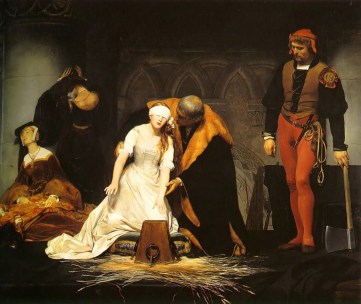
the-execution-of-lady-jane-grey.jpg

Posted in Lex scripta, O Mores!, Sisyphus | 1 Comment »

Orthomom blogger fights and wins on blogger anonymity

Posted by Ron Coleman on November 13, 2007

The New York Law Journal reports (subscription required; link to blog added):

A former Lawrence school board member’s request for disclosure of the names of anonymous Internet critics has been rebuffed by a state judge, who ruled that the comments were protected speech.In a proceeding for pre-action discovery, Manhattan Supreme Court Justice Marcy S. Friedman found that Google, the Internet service provider hosting the blog “Orthomom,” did not have to disclose the identities of blogger Orthomom or of the anonymous users who posted allegedly defamatory comments on the site about Pamela Greenbaum.

“The Lawrence school district has been the arena for a highly charged dispute between the public school minority, which Greenbaum represents, and the private school majority, over the extent to which the Lawrence public schools should serve the Orthodox Jewish community,” wrote Justice Friedman in Greenbaum v. Google, Inc., 102063/07. “The relief sought by Greenbaum, on the eve of a school board election, would have a chilling effect on protected political speech.”

The decision is here. I have said this before: The pendulum has swung too far in favor of Internet anonymity and has virtually made libel, if it is done online, a non-existent tort. On the other hand, when the comments and statements in question are themselves not actionable — here they seem to be mere opinion, which can never be the basis for a defamation action — it appears that anonymity should be protected.

That doesn’t mean there is no societal cost to enabling non-actionable slander. An opinion can be harmful, and there is no inherent reason why the victim of slanderous opinions should not know who is uttering them. Short of fear of the Klan or the local drug kingpin, most anonymous commentary is simply a matter of moral cowardice. But it is well established that defamation suits have a way of chilling even meritorious free speech. Until we find a way to make people accountable for what they say that does not hinge on legal sanctions, this unfortunate form of asymmetrical assault will remain with us.

(Cross-posted at LIKELIHOOD OF CONFUSION®.)

Posted in Blogophilia, Lex scripta, Oppression | Leave a Comment »

Handsome but not home free

Posted by Ron Coleman on November 6, 2007

A New York state criminal court judge, not unexpectedly, rejects the decision of the U.S. Court of Appeals for the District of Columbia in Parker v. District of Columbia, and rules that Rashawn Handsome has no “a constitutional right to bear arms [that] protected his keeping three unlicensed handguns in his apartment,” according to the New York Law Journal (subscription required) :

In refusing to follow Parker, Judge Gerstein noted that the ruling’s conclusion is at odds with the holdings of nine other circuits and the last U.S. Supreme Court decision to address the issue, U.S. v. Miller, 307 U.S. 174 (1939). All those rulings concluded that the Second Amendment, rather than creating a personal right to bear arms, circumscribes potential efforts by the federal government to curb state militias.

While the Second Circuit has not directly addressed the issue, Judge Gerstein wrote, it observed in a 1984 ruling that “the right to possess a gun is clearly not a fundamental right” (U.S. v. Toner, 728 D.2d 115).

The U.S. Supreme Court in Miller and the nine circuits agreeing with it, Judge Gerstein noted, all considered the prefatory clause of the Second Amendment controlling.

In its entirety, the Second Amendment reads: “A well regulated Militia, being necessary to the security of a free state, the right of the people to keep and bear Arms, shall not be infringed.”

Mr. Handsome’s argument relying on the Parker case to overturn New York’s law “requires rejection of viable Supreme Court precedent and half of the [Second] Amendment’s text,” Judge Gerstein wrote.

The New York decision is here. It may not do justice to the learned opinion or the level of complexity surrounding this issue, but it is certainly a full-bore gun control opinion. In short, it rejects the assertion that there is any independent right to bear arms except in connection with the establishment of a “well-regulated militia” or that the right to bear arms could be numbered among the fundamental individual rights of the Constitution such as free speech. On the one hand, the New York Times quoted former Chief Justice Warren Burger as saying, “The Second Amendment doesn’t guarantee the right to have firearms at all,” and calling the individual rights view “one of the greatest pieces of fraud — I repeat the word ‘fraud’ — on the American public by special interest groups that I have ever seen in my lifetime.” In the same article, however (hat tip to Instapundit), no less a liberal light — and considerably more respected legal scholar than Burger, who was not really regarded as an intellectual heavyweight — comes to the exact opposite conclusion.

Judge Gerstein’s opinion does note that, unlike the D.C. statute that was overturned, the New York statute does not purport to be a total ban, merely a (draconian) licensing and regulation scheme. That means that even if, in the fantasy world of gun rights enthusiasts (such as myself — why, some day I may even see a real gun thingy up close), the Supreme Court were to take up and affirm the Parker decision, this New York law would probably be unaffected.

Posted in Lex scripta, Politics and Poker | 10 Comments »