Likelihood of Success

Ron Coleman’s pretty good blog

Archive for the ‘Past is prologue’ Category

The lights go out in Georgia

Posted by Ron Coleman on August 10, 2008

It’s not even close:

U.S.-allied Georgia called a unilateral cease-fire — “We are not crazy,” said President Mikhail Saakashvili — and claimed its troops were retreating Sunday from the disputed province of South Ossetia in the face of Russia’s far superior firepower. Russia said the soldiers were “not withdrawing but regrouping” and refused to recognize a truce.

The tactical reality is completely besides the point, actually. The Georgia adventure will always be remembered as Putin’s Grenada: An opportunity to rationalize a strategically meaningful, but far more symbolically significant, local annoyance into a mismatched demonstration of new resolve, a shaking off of reluctance to utilize force, and an opportunity for cheaply-bought national pride. For Putin, it is all that and more, seeing as how his project is so essentially revanchiste, and the ongoing existence of Georgia both as an independent state and a putative American ally is an ongoing poke in the eye to his neostalinist dreams.

Roger Kimball’s article (via Glenn) comparing the McCain and Obama statements on the situation also demonstrates nicely how, like the Grenada invasion, the Putin war on Georgia has the quality of distilling a wide range of political and moral realities. So many Cold War moments do.

Cross-posted on Dean’s World.

Posted in Euroids, Oppression, Past is prologue, Politics and Poker, Stragety | 2 Comments »

The Ninth of Av

Posted by Ron Coleman on August 8, 2008

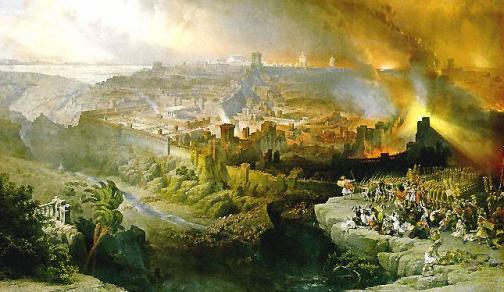
destruction-full.jpg

Jewish tradition teaches that on Tisha B’Av (the Ninth day of the month of Av) , five national calamities occurred:

  1. During the time of Moses, Jews in the desert accepted the slanderous report of the ten spies, and the decree was issued by God forbidding them from entering the Land of Israel. (1312 BCE — traditional Jewish dating)
  2. The First Temple was destroyed by the Babylonians, led by Nebuchadnezzar. 100,000 Jews were slaughtered and millions more exiled. (586 BCE)
  3. The Second Temple was destroyed by the Romans, led by Titus. Traditional sourcest teach that two million Jews died, and another one million were exiled. (70 CE)
  4. The Bar Kochba revolt was crushed by Roman Emperor Hadrian. The city of Betar — the Jews’ last stand against the Romans — was captured and liquidated. Over 100,000 Jews were slaughtered. (135 CE)
  5. The Temple area and its surroundings were plowed under by the Roman general Terentius Rufus. Jerusalem was rebuilt as a pagan city — renamed Aelia Capitolina — and access was forbidden to Jews.

Other grave misfortunes throughout Jewish history occurred on the Ninth of Av, including:

  1. The Spanish Inquisition culminated with the expulsion of Jews from Spain on Tisha B’Av in 1492.
  2. World War One broke out on the eve of Tisha B’Av in 1914 when Germany declared war on Russia. German resentment from the war set the stage for the Holocaust.
  3. On the eve of Tisha B’Av 1942, the mass deportation began of Jews from the Warsaw Ghetto, en route to Treblinka.

More here on the Ninth of Av, which begins Saturday night. Observant Jews will fast (a complete fast — no food, no water) until nightful Sunday night. For us, this is the “hardest” day of the year.

Adapted from last year.

Posted in Faith and Works, Heart and spirit, Oppression, Orient, Past is prologue | Leave a Comment »

How to write books in a prison camp

Posted by Ron Coleman on August 4, 2008

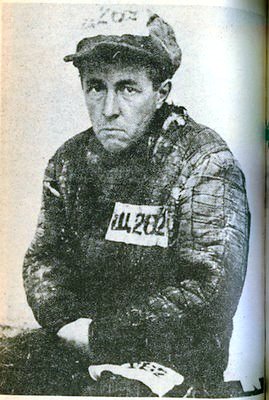
The Zek

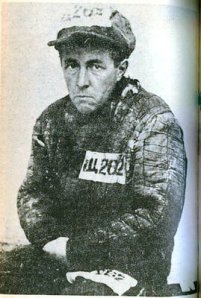
The Zek

How Aleksandr Solzhenitsyn, whose death I noted yesterday, did it — in the New York Times obituary:

At Ekibastuz, any writing would be seized as contraband. So he devised a method that enabled him to retain even long sections of prose. After seeing Lithuanian Catholic prisoners fashion rosaries out of beads made from chewed bread, he asked them to make a similar chain for him, but with more beads. In his hands, each bead came to represent a passage that he would repeat to himself until he could say it without hesitation. Only then would he move on to the next bead. He later wrote that by the end of his prison term, he had committed to memory 12,000 lines in this way.

That’s all there is to it, I guess.  It’s easy to be stunned by this feat, even by a mathematician, and forget about writing the 12,000 lines, and writing them the way he did.  When do heart, soul and mind so powerfully coalesce in one body?

None of this is to say that I agree with every little thing Solzhenitsyn thought or said.  His affection for the neo-Stalinist regime in Russia today is hard to fathom, nationalism notwithstanding.  Yet he did write in The First Circle, forgive my not having it exactly, “The wolf is not blameworthy, but the cannibal is” — he was a nationalist, it was a world of carnivores; and Stalin’s crime was not merely that he was a murderer but that he murdered his own people. The crack that this leaves open for murdering others is not untroubling, but in truth Solzhenitsyn never advocated or defended that.

Still and all Solzhenitsyn was one of the towering figures of the last century.  Liberals, for a brief moment, recognized his courage and his brilliance, even as pragmatic conservatives such as Henry Kissinger found him inconvenient, an embarrassing guest at the table of detente, and shooed him away from the Ford White House.  After a while it seemed as if Solzhenitsyn no longer had anything to say to us.  Yet much of what he did say in terms of criticism of the West — the materialism, the moral vacuity, the lack of true spirituality — should not be as readily laughed away by thoughtful people as is depicted having been the case among the literary elite in the obituary.  Nor was the accusation against him of antisemitism, in any meaningful sense, justified; familiarity with his works cannot support the claim.

You must read the whole obituary.  If you don’t really know who Solzhenitsyn was or how he did what few writers dream of — actually had an effect on history — this is your chance.  Do not pass it by.  Don’t you want to understand what our world is, and more of how it got this way?

Posted in Ars Longa, Faith and Works, Heart and spirit, Oppression, Past is prologue, Sisyphus | 3 Comments »

Socialism, law and order

Posted by Ron Coleman on July 20, 2008

Wolf Howling makes a thorough argument that socialism, not “mere” liberalism, is at the root at the disintegration of law and order in Britain, which you have to read in full to appreciate. The conclusion:

This is all a case study in why the philosophy of Karl Marx should have been interred with his bones. Instead, it is alive and thriving – much like a malignant cancer – in Britain today. Either Britain will dispense with socialism or Britain will eventually crumble. I am an optimist and an anglophile, and thus my bet is on the former. But I am also a bit of a realist. Given the stranglehold of socialists on all the reigns of power in Britain, and in particular in academia and the news, the latter is a real possibility also.

There may always be “an England,” because it’s a big place and it’s hard to sink an island in the sea, and who would want to? But there may not always, necessarily, be England.

Were we wrong to think that’s a bad thing? I can’t quite bring myself around to that, though there are aspects of the enterprise that have far outlived their usefulness. But it’s hard to be optimistic about England’s future.

Cross-posted on Right-Wing News.

Posted in Euroids, Heart and spirit, Past is prologue, Politics and Poker | 2 Comments »

No, you first!

Posted by Ron Coleman on July 13, 2008

Timothy Noah reveals an uncomfortable truth about the Warren Christopher / James Baker Road Show:

Congress doesn’t want to streamline its role in declaring war, because, for all its bluster (not to mention its constitutional responsibility), Congress doesn’t want to be held politically accountable for the results. . . .

Congress has all the war-making power it needs, and considerably more than it wants. The latter problem can’t be solved legislatively. Cowardice, opportunism, and indecision inhabit a realm beyond the reach of law, and you’d think that two experienced hands like Baker and Christopher would understand that better than most.

You have to already wonder why anyone would want to listen to two mediocre former secretaries of state about almost anything.  The fact that they’re not the worst-ever retirees from that position (a group that includes Cyrus Vance and of course Ramsay Clark) doesn’t help.

But Noah is right:  Congress wants plausible deniability, above all.  Look how nicely that played out over the Iraq War, after all.

Posted in Americana, Past is prologue, Politics and Poker | Leave a Comment »

Blood, sweat, toil, tears and Dan Rather’s word processor

Posted by Ron Coleman on May 6, 2008

Creepy:

British historians called Tuesday for a public report on the inquiry into 29 forged documents found at the National Archives that falsely accuse Winston Churchills government of having a secret, cordial relationship with Nazi SS chief Henrich Himmler at the height of World War II.

Eight leading historians signed an open letter urging police to take action against the suspect who faked the documents, which also allege that Churchill ordered the assassination of Himmler to keep the discussions secret. . . .

[C]oncerns about the authenticity of the documents were raised after [an expert] saw unexplained pencil marks beneath some of the signatures. He was also deeply suspicious about the use of some phrases, such as “devastating repercussions,” that were not widely used in the 1940s.

Okay, maybe they were forged. But couldn’t they still be fake but accurate?

Posted in Past is prologue | 3 Comments »

Decline and fall

Posted by Ron Coleman on May 4, 2008

Lexington Green:

[P]utting aside the bogus and irresponsible notion of “unipolarity”, I suppose it is fair to say, in a taxonomic rather than invidious way, that America is the global hegemon. It is the primary provider of security, it is the primary determiner of the rules of the international game, etc.

So let’s be charitable to Mr. Haass and say that he is really talking about the displacement of the USA as the global hegemon. He does mix up his terms and also refers to the end of U.S. “primacy” – a word he uses incorrectly as if were synonymous with “unipolarity”.

The last global hegemon, Britain, was superseded by a much bigger entity, the good old USA. That transition process was ugly. It involved two world wars and a global depression.

I see no entity that can fill the role of global hegemon in the place of the USA.

The EU cannot do it. China cannot yet do it.

Many players have a stake in the US-led world order, and whatever irritation American primacy may cause, they will prefer the devil they know and will not like to see the uncertainly and risk of a new one replacing it.

I remember hearing about the imminent decline of the “American Empire” since the early 1970’s. It grows tired, and it it premised incorrectly on the assumption that, just as previous hegemons have declined, so must all hegemony. Lexington Green explains why, as a local matter, that does not seem likely at the moment. But there are other reasons why it is possible, perhaps, that American dominance could in fact last much, much longer than predicted by two main types of people: Those antagonistic to it, mainly on the left, and those on the right who pretend to rue its inevitable collapse, but really use predictions of such collapse as a rhetorical device to urge (typically reactionary) policies that are “the only way” to save Old Glory. What are these possible reasons?

  • Notwithstanding the serious flaws in our democracy and our 220 East 42ndconstitutional order — mainly too much of the former, mainly as it affects fiscal matters, and two little respect for the latter — it is not too much to say that no previous hegemonic power has been premised on a fundamentally free social and political order. The result is a level of internal social and political dynamism that would seem to militate against the sort of long run “internal rot” phenomenon experienced by the Roman and Ottoman empires, for example, or the somewhat different process of ossification, leading to self-doubt and moral cowardice experienced by the British Empire.
  • Related, but not necessarily guaranteed as a twin of the foregoing, is America’s fundamental commitment to the free market in economics. The supposed imperial project here, while surely interested in and committed to protection of its economic interests (i.e., petroleum and other supplies) by use of military and other strong projections of power, is not — unlike the mercantilism of the British Empire or the socialist fantasy / coercive reality of the Soviet empire — axiomatically, or even actually, driven by economic need. (This is true notwithstanding what the exact opposite assertion your Marxist professors teach you in college.) To the contrary, the free market is extraordinarily forgiving of foreign policy externalities that are predicted to have this or that catastrophic effect — when it is given half a chance actually to operate.
  • The American social order, the Shining City on the Hill, is historically premised on sincere religious belief premised on wide-eyed religious idealism. It does not always live up to the ideals of that belief, but the strain of idealism that animates “Americanism” cannot be found in Anglicanism, a church whose roots were essentially in realpolitik, nor in the cynical metropolitan paganism of Rome. The Ottoman empire also was founded on a profound religious faith, true — but as history seems to demonstrate, Christianity is probably a better foundation for building a healthy political and economic system, especially under modern and modernizing conditions, than Islam.
  • America is not an empire. The modern conception of hegemony allows for more shifts, realignments and tactical withdrawals than the traditional institution of empire could. This means America can, as a practical matter, control less in its sphere of domination than the Soviet or Roman emperors could in their time. But it probably also means it can, ultimate, control more that it needs to in order to maintain the level of dominance that suits its interests.

I could be wrong. It could all fold tomorrow. And it may not be all that terrible if it does. But considering that “they’ve” been predicting that tomorrow as frequently as Paul Krugman predicts imminent recession, and for even longer, thinking about these points could make your next cocktail party chat on this topic a little more interesting.

Cross-posted on Right-Wing News.

Posted in Americana, Past is prologue, Stragety | 3 Comments »

Wearing the pants

Posted by Ron Coleman on May 1, 2008

Gil Student:

An article from two weeks ago about a men’s haggadah and the general lack of male participation in Reform communities (Jewish Week). This week, my old friend Dr. Judith Rosenbaum replies in a letter and states that the claim that Judaism has been feminized “has been heard in every generation since the 19th century” (Jewish Week).

What an odd response. The decline of Jewish religious practice, continuity and community, by and large, across the mass of worldwide Jewry since the 19th century is hardly controversial. What’s the point of asking, “Oh, they’ve been complaining about a precipitous decline ever since the precipitous decline”?

Answer: Dr. Rosenbaum not only has no problem with the fact of feminization of any culture, much less Judaism’s traditionally (and to some extent notionally) patriarchical culture, she’s way in favor of it, and not too concerned about the implications for continuity of such a culture in anything like a traditional form.

She more or less comes out and says that, but then the point about “oh, that old saw” is not only irrelevant, it’s misleading. Or “ms.” leading, you could say.

UPDATE:

AMERICAN JUDAISM FACES A SHORTAGE OF MEN: “Contemporary liberal American Judaism, although supposedly egalitarian, is visibly and substantially feminized.”

Posted in Faith and Works, Past is prologue | 1 Comment »

Constantine’s Sword

Posted by Ron Coleman on April 30, 2008

My annoying friend David Kelsey has got a great-guns discussion going about the movie version of Constantine’s Sword, a book I read and enjoyed a few years ago, with certain reservations — mainly that author James Carroll, a former Catholic priest, comes out by the end sounding so politically correct and essentially anti-Catholic that his “new” views seem to color what would otherwise have been very illuminating analysis of a critical turning point in the history of the Church, especially, yes, as it relates to Jews. I’m also a little suspicious of his little Freudian motif he weaves throughout.

This is always a hot-button topic. There is something in me that won’t let me join the chorus of otherwise nearly universal Jewish condemnation of the history of the Church, right up through more or less present times. And I am not quite sure what that something is.

Cross-posted on Dean’s World.

Posted in Faith and Works, Past is prologue | 5 Comments »

No more pretenders

Posted by Ron Coleman on April 30, 2008

Associated Press:

DNA tests carried out by a U.S. laboratory prove that bone fragments exhumed last year belong to two children of Czar Nicholas II, putting to rest questions about what happened to Russia’s last royal family, a regional governor said Wednesday.

Bone fragments dug up near the Ural Mountains city of Yekaterinburg are indeed those of Crown Prince Alexei and his sister, Maria, whose remains had been missing since the family was murdered in 1918 as Russia descended into civil war, said Eduard Rossel, governor of the Sverdlovsk region.

An amazing thing, to resolve a great historical question this way. The Romanov Dynasty was wicked and cruel as a whole, but there was no moral basis — other than Leninist “revolutionary justice” — to kill the children of tsar. They were killed, and brutally too, and now any lingering questions would seem to be resolved.

Posted in Oppression, Past is prologue, Scientificus | 1 Comment »