Likelihood of Success

Ron Coleman’s pretty good blog

The sound of one hand napping

Posted by Ron Coleman on September 5, 2007

Sam Brownback went to New Hampshire, where no one noticed.

Maybe the Senator himself will notice.

I think he’s a good man. Had dinner with him and a few friends in New York once. But presidential-wise, this is not happening, at least not soon.

It’s easy to make fun of people who try to achieve something and fail. We do it all the time with politicians; I do it, too, I guess, though not usually for failures in this vein. I am sure Sam Brownback does not want our pity, either.

It’s character-building, though, and Brownback already has plenty of that. So it’s time to go home.

UPDATE (bumped up):  The Brownback campaign kind of fires back.  I mean, they emailed me this link.  Me.  That has to hurt.

UPDATE: On the other hand, I don’t know. Maybe some people — yes, like Larry Craig — just bring mockery on themselves.

Posted in Politics and Poker, Sisyphus | 1 Comment »

Inventory this

Posted by Ron Coleman on September 4, 2007

Meryl Yourish reports that it’s getting hairy for Scientology in Western Europe.

Maybe that’s why they’re hanging around the subways in New York all the time.

Posted in Euroids, Faith and Works | Leave a Comment »

“Radical Transparency”

Posted by Ron Coleman on September 3, 2007

Erik Schmidt of the Tech LawForum frets about online anonymity in a thoughtful undated article that has just come to my attention, but questions the conclusions in the piece published here where I posit the end of the world due to “assymetric personal warfare.” He writes:

Do the anonymous defamers really hold all the cards online? Sure, like guerrilla fighters, they can blend into the background at will, popping up again later to stir up trouble. But even the most cursory glance at AutoAdmit discussions reveals an abundance of name-calling, random stupidity (”LOL YALE IS TEH GAY!!!”), and insecurity. In examining online defamation, wouldn’t it be useful to inquire as to the reasonableness of giving any credibility to the statements being made?

Assuming the sixteen law firms that didn’t give the Yale grad callbacks actually believed these anonymous statements, I refer them to the words my father told me when I was just a wee lad: “Don’t believe everything you read.” To that I’d add, “especially online.”

A good moral lesson, but what does that do for the non-admitted student?

Schmidt wants to answer as follows, I think: The rational, utility-maximizing 17th law firm follows Old Man Schmidt’s good advice and doesn’t believe what’s written online… does hire the applicant… and does benefit from that decision. In the long run, the other 16 do what they did after generations of not hiring Jewish applicants, and realize other firms are stealing a march on them because of their irrational hiring practices, and start hiring qualified Jews, or in this case qualified victims of anonymous defamation, because it is in their economic interest to do so. A good, invisible-hand, who-needs-the-state answer to irrational discrimination.

Could be. That’s a good answer, Eric. Meanwhile, though, the long run often feels like a place in an economist’s dream. By the time the white-shoe firms started hiring Jews, the Jews had found homes in their “own” law firms, many of which are the most powerful firms in the world today. In New York terms, it was ultimately competitive pressure from the Weil Gotshals and Wachtell Liptons that opened the door for my fellow one-time pariahs at places such as Cravath Swaine & Moore and Davis Polk & Wardwell. That process took nearly a century from the time that Jews started graduating from law schools in numbers.

Now, what’s the analogy for victims of online defamation? Colonies of other fellow Internet fallout victims? Perhaps an answer will reveal itself faster than a 100 years; perhaps not only disease, but remedy, spreads faster in Internet time. Perhaps.

Posted in Blogophilia, Past is prologue, Stragety | 2 Comments »

One small step backward for a man

Posted by Ron Coleman on September 3, 2007

One giant leap in reverse for logic and public policy debate. Instapundit falls for the “man on the moon” fallacy:

Arianna Huffington … asks: “In the Age of Terror, Isn’t Busting Toe-Tappers an Insane Use of Our Law Enforcement Resources?” Put me down for a yes vote on that one.

It’s the same argument, just sideways, as the old, “If they can put a man on the moon, why can’t they ” — anything. Anything that has nothing to do with putting a man in the moon. It is a fallacious argument meant to simulate the argument a fortiori, to wit, if they can do the larger A (put a man on the moon) surely then can do the much, much “smaller” B (serve good food on an airplane, get the cable guy to come on time, whatever). Of course B does not in any way flow from such an A; the issues are unrelated; there is no such proof.

Here, too, a major and minor premise are advertised as related and one deducible from the other, but here it is in reverse: If we have time for vice squad activities by law enforcement, “all the more so” we must have already “put a man on the moon,” i.e., solved terrorism. Oh, we haven’t done B? Then what business do we have doing A?! See what a bad idea A is?

But A does not flow from B at all. They have nothing at all in common at all except for the fact that both are described under the very broad rubric of law enforcement functions. But a reduction in vice squad activity in a Midwestern city has no bearing on the resources that will actually be made available, consequently, in the activities of entirely different law enforcement agencies, in different places, involving personnel with entirely different qualifications, in fighting terrorism — just as a posited reduction in traffic enforcement, drug enforcement, zoning laws and even burglary, rape and assault investigations are utterly unrelated to terrorism. All these things are “small” B’s to the larger A, but besides being smaller and both being done by people allowed to carry guns, they are completely unrelated.

It’s a very bad faith argument, a cloak for the true argument, which is, “I don’t like public morals laws.” So then come out and say that, and make that case. But the juxtaposition with terrorism is the chicken’s way out. It not only cloaks the bad argument but wraps the maker in a cynical mantle of patriotism and concern with terrorism. I’m not surprised to see it from the phony Huffington. As to Instapundit — here Glenn is simply caught up in his libertarian disdain for public morals laws and has switched his law professor brain entirely in favor of a head full of mush.

Too bad. If Glenn is against laws that prohibit solicitation of intimate activities in public facilities, I’d like to see him make those arguments, not endorse fake ones like this. “In the Age of Terror” has no more logical force than urging your favorite policy because it’s better “for the children.”

UPDATE: A related argument, from Kim du Toit, and one from Michelle Malkin.

Posted in O Mores!, Oppression | 10 Comments »

Addicted to talk

Posted by Ron Coleman on September 3, 2007

Criminal defense lawyer Jon Katz hits on an interesting phenomenon:  The loquacious nature of the ex-addict.

Posted in Homo sapiens | Leave a Comment »

Not just the fattest

Posted by Ron Coleman on September 2, 2007

Smokestack industries are an odd topic for romance. But, like railroads, no matter how irrelevant they become to a sophisticated national economy, some folks just can’t get them out of their heart. They can’t believe that we can flourish, indeed grow wealthy, if all the heavy stuff is being shipped here in containers instead of being manufactured by our own American brethren. On the left, meanwhile, the evaporation of manufacturing in the US mean the loss of union dues that gofeeding-gargantua.jpg mainly into the coffers of Democratic politicians; thus it is frequently juxtaposed, rhetorically, with the disgusting fact that Murricans use such a shockingly disproportionate ratio of molecules for drivin’, eatin’ and just ol’ livin’.
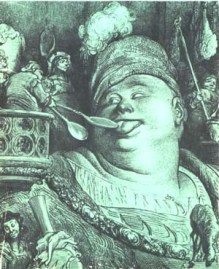
So what do when the International Labor Organization in Geneva — hey, that’s Europe! The home of the Global Test! — says there’s a darned good reason we consume such a large percentage of the world’s resources: We do a darned good job with it:

American workers stay longer in the office, at the factory or on the farm than their counterparts in Europe and most other rich nations, and they produce more per person over the year.

They also get more done per hour than everyone but the Norwegians, according to a U.N. report released Monday, which said the United States “leads the world in labor productivity.”

And we’re gunning for those Norwegians, too. More:

Only part of the U.S. productivity growth, which has outpaced that of many other developed economies, can be explained by the longer hours Americans are putting in, the ILO said.

The U.S., according to the report, also beats all 27 nations in the European Union, Japan and Switzerland in the amount of wealth created per hour of work a second key measure of productivity.

But where are all the lunchboxes and hardhats? Toxic dirt, industrial maimings and blighted landscapes? How can we be producing so much wealth if the Mexicans are building our cars and the Chinese are building everything else? Well, it’s not so simple. It’s called comparative advantage — the idea is that if everyone does what he does best, everyone benefits from an open system of trade. Both the theory and the facts bear this out. (I wish Laura Ingram would look into this, too, for the next time she has her NAFTA-bashing fraud Jerome Corsi on her show — maybe she can ask him some tough questions and avoid becoming the female Pat Buchanan on trade.) It makes everyone richer in the long run, even if some people have to adjust their expectations and their career paths, and even if millionaires such as Billy Joel and Bruce Springsteen find the plights of displaced factory workers inspiringly heartrending and the plights of foreigners who wouldn’t have jobs without free trade, and families who couldn’t afford union-manufactured goods, irrelevant.

In contrast, history proves that the alternative, high tariffs and protectionism, make all but a few — and, in the long run, pretty much everyone — a lot poorer. On the other hand, that’s good for Bruce and for Jerome Corsi, too — more material. Meanwhile, though, hopefully they’ll noisily fume, generating wealth in the process for themselves and others, and we’ll all keep being more productive, more free. Perhaps we’ll watch our appetites a bit, too, if only as a matter of dignity, taste and healthful habits.

Posted in Gelt, Stragety | 2 Comments »

PayPal’s down

Posted by Ron Coleman on September 2, 2007

According to this story, people can’t accept payments, which is one-half of the point.  It’s been a couple of days.  And no one at eBay (PayPal’s owner) seems to care.

That’s what we call a disequilibrium.

Posted in Nuvo-Techno | 2 Comments »

Phenom

Posted by Ron Coleman on September 2, 2007

Amazing:

Before Clay Buchholz made his major league debut two weeks ago, the Boston Red Sox told him he was going back to the minors — even if he pitched a no-hitter.

Got to keep the kid now.

The 23-year-old rookie pitched that no-hitter in just his second outing, using a dazzling three-pitch assortment of fastballs, curves and changeups to beat the Baltimore Orioles 10-0 Saturday night.

He might never win another game. He might not be ready. He might be anything, but one thing he is is amazing.

Anyone who thinks you can’t learn anything about real life from sports does not get it. Being good enough — getting good enough — to make it into major league play already requires enormous commitment and discipline, as much mental as physical. But what this kid did was throw a no-hitter — a task that gets geometrically harder to achieve, as a psychological matter, the further you proceed toward its completion — in one of the most intense sports environments in the world, Boston’s Fenway Park — in only his second major league game ever.

I don’t know anything about Buchholz. He could be an axe murderer, a dogfight promoter, a drug kingpin. I am not saying that professional athletes ought to normally be considered heroes for their on-field performances, nor emulated by children or adults because they are good or even great at what they do. A lot of them are huge lugs, worthless or even downright menaces to society.

People can achieve amazing things, though, on their own terms, and Clay Buchholz is one of those people — no matter who he really is and no matter what else happens.

Posted in Americana | Leave a Comment »

Chutzpah!

Posted by Ron Coleman on August 30, 2007

The burning question in Tennessee: “Why are we eating more shrimp?”

Hm. What you mean, “we,” kemosabe?img00120.jpg

And here we are, Rosh Hashana less than two weeks away!

Posted in Faith and Works, Jocularity | 7 Comments »

The Nazi mascot

Posted by Ron Coleman on August 30, 2007

Ynetnews:

Over 60 years after WWII, the secret past of a young Jewish boy adopted by SS, forced to hide his Jewish identity and used as Nazi mascot in propaganda videos is told in newly published book, ‘The Mascot’

Over 50-years after the Second World War came to an end, Alex Kurzem of Australia revealed to his family that he was a Jew who survived the war by being adopted by the SS at the age of five and becoming a Nazi mascot.

Kurzem, 70, revealed his story to his wife and two children in 1997, and now, 10 years later, a book entitled The Mascot and written by Kurzem’s son Mark, has been published in London.

“Who would have believed such a story?” Kurzem told Yedioth Ahronoth newspaper over the phone Thursday night.

If true, this is pretty impressive.  Not that anyone but specialists have ever heard of “the youngest Nazi,” but it demonstrates how little even the wicked “experts” on racial characteristics could tell when choosing their ideal Aryan.

Posted in Oppression | 3 Comments »