Likelihood of Success

Ron Coleman’s pretty good blog

With donations like that…

Posted by Ron Coleman on August 11, 2008

… you don’t need to sell things:

A bartender from Chicago, Stephanie works two jobs and wants to go back to college to study biology. After her roommate donated her eggs to a fertility clinic, Stephanie, who asked that her real name not be used to protect her privacy, said she decided to help an infertile couple and make $7,000 in the process.

Stephanie said if not for the faltering economy, she would not be donating her eggs. . . . “I make roughly $800 a week. The $7,000 will help, but its not going to pay for an education. I’m still going to have to take out loans,” Stephanie said.

Is selling something for $7,000 called “donating” now? It’s the word ABC uses in the headline, too.

Oh, and “Stephanie” the bartender’s economic analysis? Also donated, evidently. And worth every penny.

Posted in Gelt, Medialites, Sisyphus | 2 Comments »

Talking to yourself

Posted by Ron Coleman on August 11, 2008

"Yes, please, tell me more...."

"Yes, please, tell me more...."

I never understood podcasting. Not at all. Evidently, Ann Althouse has seen the light and dropped her podcasts (yes, via IP), but part of her rationale is all the fun she’s having on “Bloggingheads,” which someone must watch. I think her commenter, Bruce, gets the real point:

I never liked the podcast or video format for blogging or anything like blogging. People who read blogs tend to read lots of them and I know I do a lot of skimming. Video is far too time consuming and linear for my tastes except for where video is the essence of the information such as a spectacular short event caught on video. Even then I like having a good summary of what I’m about to watch and how long it will take.

It’s like the difference between window shopping and having some sales person give you an uninterruptable five minute pitch about the particular product they want to sell you. No matter how wonderful and interesting that person and/or product might be, I tend to react like a cat being dragged into a bath tub full of water.

Thank you, Bruce.  Why don’t most people realize that we may be interested in your message, but we don’t really want to hear about it?

Posted in Blogophilia, Medialites | 2 Comments »

Beyond resolution

Posted by Ron Coleman on August 10, 2008

It’s not the extramarital affair part, any more than it was with Bill Clinton or Eliot Spitzer, that makes the story-with-a-story about John Edwards newsworthy. Rather it was the indignant denials from his “camp,” the hypocrisy from someone who made moral judgment of others the linchpin of his platform. And in this case — arguably unlike the others — it’s the gross media favoritism shown in ignoring, even squashing, a legitimate news story about a liberal candidate even as both equivalent news and even utterly unsubstantiated smears about conservatives are regarded as fair game in the MSM.

It was last March when I wrote:

John Edwards — whom, I will admit, I never liked politically, though of course our sympathy must go out to him and his family on a personal level — is one of two things:

Either merely an inveterate liar, or a complete moral retard. Democrats are certainly used to having one or the other of those as their candidate, but chances are there’s at least one better one in this year’s field.

I took some heat in the comments back then and played with this issue like an old piece of gum. Well. Is our choice any clearer now?

UPDATE: Hey, and maybe it actually even mattered?

UPDATE: Ouch!  (And more ouch.)

Posted in Americana, Medialites, Narcissus Rex, O Mores!, Politics and Poker | 5 Comments »

The lights go out in Georgia

Posted by Ron Coleman on August 10, 2008

It’s not even close:

U.S.-allied Georgia called a unilateral cease-fire — “We are not crazy,” said President Mikhail Saakashvili — and claimed its troops were retreating Sunday from the disputed province of South Ossetia in the face of Russia’s far superior firepower. Russia said the soldiers were “not withdrawing but regrouping” and refused to recognize a truce.

The tactical reality is completely besides the point, actually. The Georgia adventure will always be remembered as Putin’s Grenada: An opportunity to rationalize a strategically meaningful, but far more symbolically significant, local annoyance into a mismatched demonstration of new resolve, a shaking off of reluctance to utilize force, and an opportunity for cheaply-bought national pride. For Putin, it is all that and more, seeing as how his project is so essentially revanchiste, and the ongoing existence of Georgia both as an independent state and a putative American ally is an ongoing poke in the eye to his neostalinist dreams.

Roger Kimball’s article (via Glenn) comparing the McCain and Obama statements on the situation also demonstrates nicely how, like the Grenada invasion, the Putin war on Georgia has the quality of distilling a wide range of political and moral realities. So many Cold War moments do.

Cross-posted on Dean’s World.

Posted in Euroids, Oppression, Past is prologue, Politics and Poker, Stragety | 2 Comments »

The Ninth of Av

Posted by Ron Coleman on August 8, 2008

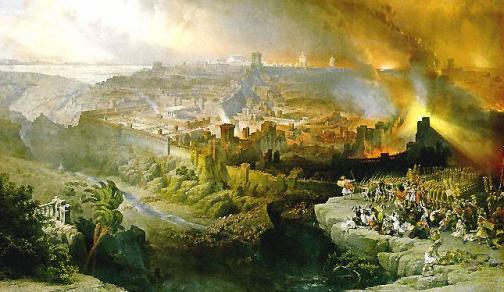
destruction-full.jpg

Jewish tradition teaches that on Tisha B’Av (the Ninth day of the month of Av) , five national calamities occurred:

  1. During the time of Moses, Jews in the desert accepted the slanderous report of the ten spies, and the decree was issued by God forbidding them from entering the Land of Israel. (1312 BCE — traditional Jewish dating)
  2. The First Temple was destroyed by the Babylonians, led by Nebuchadnezzar. 100,000 Jews were slaughtered and millions more exiled. (586 BCE)
  3. The Second Temple was destroyed by the Romans, led by Titus. Traditional sourcest teach that two million Jews died, and another one million were exiled. (70 CE)
  4. The Bar Kochba revolt was crushed by Roman Emperor Hadrian. The city of Betar — the Jews’ last stand against the Romans — was captured and liquidated. Over 100,000 Jews were slaughtered. (135 CE)
  5. The Temple area and its surroundings were plowed under by the Roman general Terentius Rufus. Jerusalem was rebuilt as a pagan city — renamed Aelia Capitolina — and access was forbidden to Jews.

Other grave misfortunes throughout Jewish history occurred on the Ninth of Av, including:

  1. The Spanish Inquisition culminated with the expulsion of Jews from Spain on Tisha B’Av in 1492.
  2. World War One broke out on the eve of Tisha B’Av in 1914 when Germany declared war on Russia. German resentment from the war set the stage for the Holocaust.
  3. On the eve of Tisha B’Av 1942, the mass deportation began of Jews from the Warsaw Ghetto, en route to Treblinka.

More here on the Ninth of Av, which begins Saturday night. Observant Jews will fast (a complete fast — no food, no water) until nightful Sunday night. For us, this is the “hardest” day of the year.

Adapted from last year.

Posted in Faith and Works, Heart and spirit, Oppression, Orient, Past is prologue | Leave a Comment »

Vanity press

Posted by Ron Coleman on August 7, 2008

Instapundit links to a Drudge report that no one is buying Nancy Pelosi’s book. That’s hardly surprising; most congressional “leaders” are uninspiring and uninspired. The support of their respective caucuses is in fact a counter-indication of originality or boldness, which are just about the only thing anyone reading a book by a politician can hope for. (Unless he’s really skinny, I guess.)

The sad part for Pelosi is that the practice by which publishers bestow massive donations on their favored politicians via utterly unrecoverable publishing “advances” was barred by the House of Representatives. Therefore she could not get even a fraction of the phenomenal sweetheart advance paid to then Senator-elect Hillary Clinton for her various scribblings — which, while they were bought by many, still did not come close to earning out the advance paid by a publishing industry supposedly beset by economic crisis.

That means Pelosi must have really thought people would want to buy her book.

Chilling. That’s what enough time in Congress does to people.

UPDATE: Left-wing “media monitor” Media Matters insists that the Hillary Clinton book did, in fact, earn out its advance — making it the exception that proves the rule, but an exception nonetheless. Read the rest of this entry »

Posted in Gelt, Narcissus Rex, Politics and Poker | 7 Comments »

Timothy Noah, master of self parody

Posted by Ron Coleman on August 6, 2008

I kept checking to make sure this wasn’t just something I missed on April 1st, but no:

When white people are invited to think about Obama’s physical appearance, the principal

Boy, could this guy pass!

Boy, could this guy pass!

attribute they’re likely to dwell on is his dark skin. Consequently, any reference to Obama’s other physical attributes can’t help coming off as a coy walk around the barn. A whole genre of humor turns on this reality. A Slate colleague informs me that an episode of the TV sitcom Happy Days (“Fonzie’s New Friend”) had its 1950s-era characters nervously discussing the fact that a black man in their midst was so … skinny. Was it true that skinny people liked fried chicken? That they were good at basketball? And so on.

No, really. Seriously.

So we, who thought we could take some solace regarding our melanin deficiencies in our endowments of underlying flesh, turn out to be no-good racists again on that score too.

I feel like a bit, fat idiot.

UPDATE:  Racist idiot, that is.  (Via Glenn.) (Bumped.)

Posted in Homo sapiens, Politics and Poker, Sisyphus, Style | 4 Comments »

Copyright law has been stood on its head and Bill Patry doffs his cap

Posted by Ron Coleman on August 5, 2008

Copyright doyen Bill Patry explains why he shut down his brilliant copyright law blog. Some of it had to do with his inability to prevent people from ascribing his personal views to his employer, Google. Some of it had to do with a sort of spiritual exhaustion (despite being a pretty spiritual guy). But naturally, this is the reason that got my attention:

Copyright law has abandoned its reason for being: to encourage learning and the creation of new works. Instead, its principal functions now are to preserve existing failed business models, to suppress new business models and technologies, and to obtain, if possible, enormous windfall profits from activity that not only causes no harm, but which is beneficial to copyright owners. Like Humpty-Dumpty, the copyright law we used to know can never be put back together again: multilateral and trade agreements have ensured that, and quite deliberately.

It’s depressing, and he’s probably right. Again: He says copyright’s “principal functions now are to preserve existing failed business models, to suppress new business models and technologies, and to obtain, if possible, enormous windfall profits from activity that not only causes no harm, but which is beneficial to copyright owners.”

What ever kind of thing could he be talking about? (Hat tip to Carol Ruth Shepard.)

Cross-posted in slightly expanded form on LIKELIHOOD OF CONFUSION®.

Posted in Blogophilia, Gelt, Lex scripta | 1 Comment »

How to write books in a prison camp

Posted by Ron Coleman on August 4, 2008

The Zek

The Zek

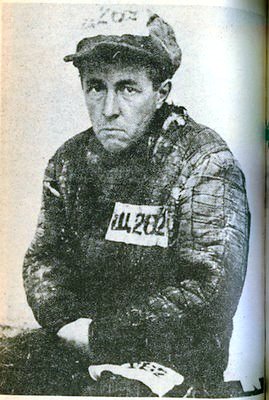
How Aleksandr Solzhenitsyn, whose death I noted yesterday, did it — in the New York Times obituary:

At Ekibastuz, any writing would be seized as contraband. So he devised a method that enabled him to retain even long sections of prose. After seeing Lithuanian Catholic prisoners fashion rosaries out of beads made from chewed bread, he asked them to make a similar chain for him, but with more beads. In his hands, each bead came to represent a passage that he would repeat to himself until he could say it without hesitation. Only then would he move on to the next bead. He later wrote that by the end of his prison term, he had committed to memory 12,000 lines in this way.

That’s all there is to it, I guess.  It’s easy to be stunned by this feat, even by a mathematician, and forget about writing the 12,000 lines, and writing them the way he did.  When do heart, soul and mind so powerfully coalesce in one body?

None of this is to say that I agree with every little thing Solzhenitsyn thought or said.  His affection for the neo-Stalinist regime in Russia today is hard to fathom, nationalism notwithstanding.  Yet he did write in The First Circle, forgive my not having it exactly, “The wolf is not blameworthy, but the cannibal is” — he was a nationalist, it was a world of carnivores; and Stalin’s crime was not merely that he was a murderer but that he murdered his own people. The crack that this leaves open for murdering others is not untroubling, but in truth Solzhenitsyn never advocated or defended that.

Still and all Solzhenitsyn was one of the towering figures of the last century.  Liberals, for a brief moment, recognized his courage and his brilliance, even as pragmatic conservatives such as Henry Kissinger found him inconvenient, an embarrassing guest at the table of detente, and shooed him away from the Ford White House.  After a while it seemed as if Solzhenitsyn no longer had anything to say to us.  Yet much of what he did say in terms of criticism of the West — the materialism, the moral vacuity, the lack of true spirituality — should not be as readily laughed away by thoughtful people as is depicted having been the case among the literary elite in the obituary.  Nor was the accusation against him of antisemitism, in any meaningful sense, justified; familiarity with his works cannot support the claim.

You must read the whole obituary.  If you don’t really know who Solzhenitsyn was or how he did what few writers dream of — actually had an effect on history — this is your chance.  Do not pass it by.  Don’t you want to understand what our world is, and more of how it got this way?

Posted in Ars Longa, Faith and Works, Heart and spirit, Oppression, Past is prologue, Sisyphus | 3 Comments »

Solzhenitsyn and me

Posted by Ron Coleman on August 3, 2008

Alexander Solzhenitsyn died. (UPDATE: New York Times obituary here.) Two years ago this October, on the occasion of the even of elections, I wrote on Dean’s World the following about how and why I became a conservative. That story began with Alexander Solzhenitsyn:

I recognized that I was a conservative during high school, when in support of a paper I was writing on Solzhenitsyn in a senior-year comparative literature class my ethnic-Polish teacher gave me a stack of American Spectator magazines, one of which included an article on Solzhenitsyn by Malcolm Muggeridge.

The entire gestalt of it just spoke sense to me. Was it a reaction to the tepid, petrified left-wing Jewish labor socialism of my extended family? The anger of a first-generation American (on one side) at a society that seemed (remember, I grew up in the ’60’s) so inexcusably and utterly unwilling to defend itself against what anyone could see was subversion? “Common sense,” as a Princeton friend, later dropout and current Washington operator would later describe it when recruiting me for some Reagan-era campus political / social suicide mission? Maybe it was just the natural inclination of one identified as depressingly adultoid from an absurdly young age and whose picture can be found at the Wikipedia entry for “stick in the mud.” I don’t really know, but I do remember that when I told my college roommate that I had, upon my return from an Israel program for Jewish searchers, become committed to religious observance, he said, “Well, now at least your religious ethic matches your political one” (or words to that effect).

Be that as it may, it is truth to me, even though politics, and most politicians, turn my stomach. I mean, there is some ethic in there, isn’t there?

But at the end of the day, these Democrats are the ones who so undermined the world I remember growing up in, and they continue to do so today. They are not even in the league, for patriotism and love of country and decency, of the Democratic politicians of my early youth — Lyndon Johnson, Roberty Kennedy, Hubert Humphrey. With McGovern, that ended.

Jimmy Carter sealed the deal. He made being an American embarrassing, humiliating, depressing, hopeless. Wimpy. Apologetic. Cringing. Losing.

I don’t believe any of today’s Democratic leaders have improved on Jimmy Carter, except that he had the benefit of not having to kowtow, as today’s Democrats do, so grossly to identity politics of every right- and- privilege- demanding ethnic and social subcultural group, no matter how subversive; to the hard-left on abortion rights; and he was allowed to be some kind of public Christian.

I wish there were Republicans today who had a quarter of the qualities of Ronald Reagan. Here was a great man, one who never claimed for himself the mantle of a perfect or even particularly virtuous personal life; but he loved his country, knew right from wrong, and — exercising a quality that I admire for the very scold it places on one such as myself — his ability, now proved doubly and triply, to make everyone around him think he was a dumbbell when in fact he was sly as a fox. Frankly I think George W. Bush comes quite close to these qualities. But, sadly lacking the Gipper’s ability to communicate and being the literal heir to a political tradition of some ideological infirmity to a conservative — think Jim Baker, the man who made me vote for Bill Clinton in 1992 — he is not Reagan. Nor are today’s dizzy denizens of the Capitol statesmen, by and large. Were they ever? The past takes on an undeserved elegance in sepia. The crassness of living, live and unsilenceable color makes today’s professional political class seemingly harder to swallow than its predecessors — red or blue.

But every time I step into the booth I ask myself, If this candidate could choose Ronald Reagan* or Jimmy Carter to make the keynote speech at his or her party’s nominating convention, which one would he or she choose?

The choice is simple.

—
* Captain Ed [just] posted on Reagan as well, so if you’re reading this belatedly, click through to Ed’s comment.

Cross-posted on Right-Wing News.

Posted in Faith and Works, Heart and spirit, Oppression, Politics and Poker | 1 Comment »