


This is a new (to me) blog I’m going to be checking in on. I like this kind of stuff. I found it while looking for random links criticizing the practical side of Frank Lloyd Wright (it was not at all hard) to contribute to this discussion.
Archive for the ‘Ars Longa’ Category
B.E.L.T.
Posted by Ron Coleman on January 1, 2008
Posted in Ars Longa, Scientificus | Leave a Comment »
Unchained melodies
Posted by Ron Coleman on December 30, 2007

WARNER BROTHERS goes copy-protection free with DRM-less MP3 downloads at Amazon. This is a good trend.
A technological war of attrition can be very costly. (Click on the pic, by the way — it really is a marvelous Unchained Melody.)
UPDATE: Huh-boy. See here for the update.
Posted in Ars Longa, Lex scripta | 2 Comments »
“Goodbye, Harry”
Posted by Ron Coleman on December 29, 2007
More “best of,” whatever that means. Here‘s my only book review this year, which suffers at least from the deficiency of denying that it is a book review — and that, perhaps, J. K. Rowling may upend not only whatever degree of artistic resolution she achieved with the seventh book but my title as well. But I live with paradox:
I’m on my little vacation (as a self-employed professional, it’s very little indeed; but at least I am in a different place from where I 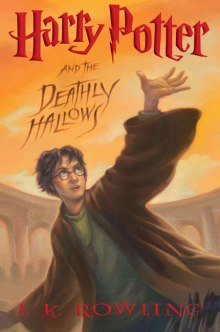 usually am, and getting a little sun and fresh air) and I just had the opportunity to finish Harry Potter and the Deathly Hallows. I liked it a lot, was very touched at a number of junctures, and feel that I was well treated by the author.
I am not a literary critic, so I am not going write a review. But here are my “bullet point” thoughts, which I throw out into the ether on the explicit premise that millions await my verdict on the last Harry Potter book, howsoever telegraphically expressed:
The series is, above all, about love. Not hardly romantic love, though more so the love among friends. But mainly it is about the love that flows from parent to child and, perhaps, from surrogate parent to child. The vehicle for the expression of love in the series is loyalty. Now, one can be loyal without love, and perhaps one can even love without excelling at loyalty; but here the true test of love is not passion, or ecstasy, or warm fuzzy feelings, but loyalty — and the sacrifice that in turn is what loyalty demands. Voldemort, of course, epitomizes the antithesis of loyalty.
We see, indeed, that loyalty is only tested, and only rendered meaningful, by self-sacrifice, a negation of the self for others; indeed this is the absolute moral and the basis of salvation at the end. This is a very Judeo-Christian message, if not the Judeo-Christian message, and all the more a shame that poorly-ground religionists condemn the books. Read the rest of this entry »
Posted in Ars Longa | 1 Comment »
My best post of the year
Posted by Ron Coleman on December 20, 2007

It was in June, and it was not written on this blog, or on Dean’s World. Tonight I was browsing friends’ blogs and came across this article, and it reminded me of what I’d written on a related topic last June. It was originally published on Beyond BT, a blog for “BT’s,” i.e., baalei teshuva — Jews who have adopted Jewish practice late in life. I have reprinted it here, changing some of the lingo and adding some explanatory links, but changing none of the self-obsession. If you don’t go in for that you can browse away now!
You can find the original post, and the extensive commentary that followed (some of it also laden with Yiddish-Hebrew terminology, however), here.
Everyone gives up something when he becomes a religious Jew, or frum. Some more than others, of course. Sometimes precious relationships are breached and, unfortunately, can never be repaired. Other times, people give up lucrative career opportunities or fame or one or another kind of social standing. These are the sacrifices that even the least learned baalei teshuva place on the altar in their service to God.
Now I, for instance, did not give up a particularly notable “party” lifestyle, including any of the elements you might associate with that; I was always on the square side. Is giving up three hours a day of TV considering giving up “something”? Hardly. As to food, I never liked shellfish. Okay, cheeseburgers, chicken parmigiana — but what serious person can reckon the loss of a particular kind of food, or even the convenience of being able to eat anywhere, serious sacrifices when offered the opportunity of personal and spiritual fulfillment in exchange?
Yes, more subtle sacrifices are the social things attendant to these physical pleasures — the inability to “go out” with friends and colleagues to restaurants, say on Friday nights. These return as momentary blips of the heart, but if a person merits the development of a decently normal frum life in a frum community and is blessed with a frum family, these are easily recognized as pleasures of dubious worth. You simply do not share the values of the people you are not going out with and as nice as all the restaurants and bars in the world look from the outside, they are — aside from the value of fellowship with any decent person, which I refuse to assign a zero value, as transient as it may be — easily recognized, also, as basically empty inside. (I do not even understand what married people are doing in restaurants at 9 PM — don’t they have families? My father was never in a restaurant on a weeknight, or in a bar, ever. Maybe that’s why I’m here with you today.) At least, I, for my part, have gotten past these, and do not struggle, even though there are pangs.
Now, I will tell you, if you agree not to tease me or make a big deal about it, that I used to be a very successful collegiate actor. You will, I hope, entertain me when I say that, back in the day, I could entertain you; that I reached a point in my college stage career that I could, and did, cause a thousand people to erupt in laughter by raising an eyebrow; that I shared the stage with a famous Hollywood star in those days and held my own, and then some. I held audiences in the palm of my hand. But do you think that is what I miss by virtue of becoming an observant Jew? It is not. In fact, even in my callow and “secular” state, I knew how preposterously unhealthy it would be to seek this dopamine rush regularly. This was so not only because the big bad world was not college, but also because I knew that almost no one makes it, or stays made, and that even those who come close get addicted to this sort of ego gratification. Most become — as we see on the gossip pages — horrid shells of people, attention and adulation junkies for whom happiness is always transient and who end up relying not just on greasepaint and hair dye but on the liquid, pill and powdered chemical substitutes for that rush. There’s no business like show business for a reason.
No, I do not miss the stage.
I miss the music. Read the rest of this entry »
Posted in Ars Longa, Faith and Works | 11 Comments »
Rolling down the river
Posted by Ron Coleman on December 17, 2007
Donald Fagen explains, as sympathetically as you can hope for, the legacy of Ike Turner.
Posted in Americana, Ars Longa | Leave a Comment »
To be a rock, and not to roll
Posted by Ron Coleman on December 4, 2007

[Stairway to Heaven] song is not just atypical of Zeppelin’s music, it is unique among their epic tracks in that it privileges melodic/lyrical development at the expense of rhythmic exploration and timbral/psychoacoustic experimentation.
Yeah, well, sure. Actually he makes some great points about what I’ve always considered the album-rock anthem of the ’70’s and how it both did and undid Led Zeppelin, as well as this surprise truism: “As Erik Davis points out in his unsurpassed book on the fourth album, ‘Stairway’ is so familiar to us that it’s a real challenge to listen to it.”
True. My “favorite song” as a teenager, I can’t stand it any more.
Posted in Ars Longa | 9 Comments »
Ticket to totalitarianism
Posted by Ron Coleman on November 25, 2007
NewsBusters prints this excerpt from the transcript of NPR’s review of “Redacted” (via Instapundit):
The rape scene has led to a familiar charge, that De Palma is a misogynist who relishes violence against women. . . .
Another charge is that he’s anti-American or anti-troops. But it’s an act of sympathy to suggest that soldiers on their third tours of duty in a place where they have no knowledge of the culture, where they can’t tell who’s on their side and who wants to blow them up, stand a good chance of losing both their moral compass and their minds. Here, and in “Casualties of War,” De Palm[a] is dramatizing the idea that even decent people in such circumstances can convince themselves they’re entitled to do anything.
Here lies the road to the complete inversion of morality. As an “act of sympathy” for the troops, DePalma is supposedly taking the position that even the worst actors in the world — U.S. troops committing atrocities while on an imperialistic mission — are no worse than morally exempt from blame for such atrocities because of the moral incoherence all around them. The logic is unassailable:
- Bad guys might be good guys.
- Good guys might be bad guys.
- Hey, this is hard!
- Let’s rape someone.
 This aligns well with the leftist conception that people the world ’round do not make their own choices at all, but rather are zombies. In America, choiceless voters are under the sway of Rush Limbaugh, religious fundamentalism, and Karl Rove. In the Middle East, suicide bombers are compelled to murder housewives and schoolchildren by their plight or by their rage. But it is relatively novel to see the left apply this to the faceless, heartless automatons of the U.S. military, even in the commission of their fictional outrages. Naturally we can expect NPR to lobby for the release of all soldiers incarcerated for improper conduct in the Iraqi theater immediately.
Soon we will recognize that everything — everything! — is George W. Bush’s fault, and that individual conscience is merely a bourgeois construct of kapital. It is so much simpler.
Cross-posted at Right Wing News.
Posted in Americana, Ars Longa, Medialites, O Mores! | 2 Comments »
Lamb chops
Posted by Ron Coleman on November 11, 2007
 All the big bloggers are all over the politics of why the “what’s so funny ’bout peace, love and understanding” moving pictures are bleeding money. But for me, it’s about the art, see?
No, not the art of movies. I haven’t been in a movie theater in over a decade. No, I mean the art of murderous movie reviewing! For example, Dana Stevens reviewed “Lions for Lambs,” the latest anti-Iraq-war agitprop from Hollywood in Slate. Well of course I’m rooting against it — but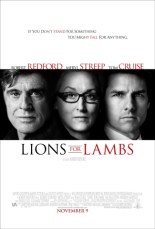 I root against just about every movie, not just because I think Hollywood is destroying this country and has become America’s calling card of moral decline around the globe. Nope — it’s because I love well written bomb reviews (yet another reason to mourn the unexplainable shift of Frank Rich, once known as the “Butcher of Broadway,” to the New York Times‘s opinionatin’ pages). Well, I wasn’t disappointed! Here are some greasy, tasty excerpts from Stevens’s review:
As you sit through the film’s 88 eternal minutes, you have to keep reminding yourself that Redford has been directing films, some of them pretty good, for nearly 30 years now. Yet Lions for Lambs appears to have been created by someone who’s never seen one of these newfangled contraptions called “movies,” or for that matter, witnessed that phenomenon known as “speech.”…
The net effect for the viewer is that of being trapped in an airless room, then escaping it to find yourself in another, and yet another….
Redford keeps cutting away to clocks as the professor’s office hour, the senator’s interview, and the soldiers’ hour of peril chug toward their respective ends. The unintended consequence is that you find yourself trying to match the real-time proceedings onscreen with the real time ticking away on your watch, and counting the seconds till you can go home.
Pass the mint jelly!
Cross-posted on Right Wing News.
Posted in Ars Longa, Politics and Poker | 4 Comments »
Norman Mailer keeps his appointment with God
Posted by Ron Coleman on November 11, 2007

Here’s a very good obituary about Normal Mailer, on whose imminent death I commented a short time ago.
Posted in Americana, Ars Longa, Homo sapiens | 2 Comments »
Working out those wands
Posted by Ron Coleman on September 24, 2007
 I’ve already commented on the wizarding economy and put forth my review of the last Harry Potter book. I recently enunciated, in my own head, something about the whole wizarding world of Harry Potter that was bothering me. And now, I share it with you.
Did you ever notice how none of the masters of wizardry, including the faculty at Hogwarts, is ever shown practicing, improving their own skills, or taking master lessons?
This is certainly just laziness on J.K. Rowling’s part, but it is very unfortunate, because of the unquestionable pedagogical influence of her work on young people. They should be given to understand that no one who is great at what they do — think Michael Jordan or Tiger Woods; Yo-Yo Ma or Wynton Marsalis — remains that way merely by virtue of acquisition of a certain set of skills at the peak of his learning experience. Great performers, artists and practitioners of all crafts practice, refine their skills, seek new challenges, and recognize their skills and abilities are either improving or deteriorating.
In the wizarding world, on the other hand, the great grown up wizards — think of Dumbledore and Snape — are evidently static in their status as wizards even though, ultimately, they are not static as characters (at least not entirely, and at least not by the end). We never see the masters doing extra reading, or adding to their repertoires, or out on the wanding range. No one learns but the students at Hogwarts.
That’s a real life lesson about excellence that the Harry Potter books could have taught with a few select sentences, and an opportunity lost by their by and large very highly accomplished author. Too bad.
Posted in Ars Longa | 6 Comments »

