Likelihood of Success

Ron Coleman’s pretty good blog

Archive for the ‘Ars Longa’ Category

Gipper Comics

Posted by Ron Coleman on September 7, 2007

Check this out, on Slate: Ronald Reagan: A Graphic Biography.

Not surprisingly, it’s not particularly sympathetic.  I don’t love the art.  But I like this kind of stuff, and in terms of anti-Reaganism, more or less of a piece with the liberal media portrayal of the man.

Posted in Americana, Ars Longa, Politics and Poker | Leave a Comment »

But, of course

Posted by Ron Coleman on August 22, 2007

From the comments in a blog post called 13 of the worst fake accents in film:

A real French accent, a native Francophone speaking English, is a wonder to listen to. Hundreds of different vowels; some from outer space. You end up wondering how two countries next to each other and always invading each other could end up with such different phonetic structures.

Zoot, now that is to laugh, non?!

Posted in Ars Longa | 1 Comment »

Goodbye, Harry

Posted by Ron Coleman on August 7, 2007

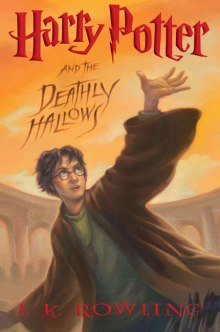
I’m on my little vacation (as a self-employed professional, it’s very little indeed; but at least I am in a different place from where I hpdhcover.jpgusually am, and getting a little sun and fresh air) and I just had the opportunity to finish Harry Potter and the Deathly Hallows. I liked it a lot, was very touched at a number of junctures, and feel that I was well treated by the author.

I am not a literary critic, so I am not going write a review. But here are my “bullet point” thoughts, which I throw out into the ether on the explicit premise that millions await my verdict on the last Harry Potter book, howsoever telegraphically expressed:

The series is, above all, about love. Not hardly romantic love, though more so the love among friends. But mainly it is about the love that flows from parent to child and, perhaps, from surrogate parent to child. The vehicle for the expression of love in the series is loyalty. Now, one can be loyal without love, and perhaps one can even love without excelling at loyalty; but here the true test of love is not passion, or ecstasy, or warm fuzzy feelings, but loyalty — and the sacrifice that in turn is what loyalty demands. Voldemort, of course, epitomizes the antithesis of loyalty.

We see, indeed, that loyalty is only tested, and only rendered meaningful, by self-sacrifice, a negation of the self for others; indeed this is the absolute moral and the basis of salvation at the end. This is a very Judeo-Christian message, if not the Judeo-Christian message, and all the more a shame that poorly-ground religionists condemn the books. Read the rest of this entry »

Posted in Ars Longa | 6 Comments »

Springtime for Osama

Posted by Ron Coleman on August 3, 2007

“Critics take aim at Bin Laden musical.”

Maybe these conspiracy guys are onto something: Why is it all right for the Jews?

I don’t think it is, either.  All right, I mean.  Brilliant, it is.  But it’s not right.

Posted in Ars Longa, O Mores!, Past is prologue | Leave a Comment »

The Last Server

Posted by Ron Coleman on July 27, 2007

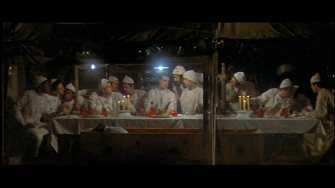
“New ‘Last Supper’ theory crashes Leonardo Web sites.”

When’s the last time you actually heard of someone crashing a Seder?

mash-supper.jpg

Posted in Ars Longa, Euroids, Faith and Works | Leave a Comment »

The invisible wand

Posted by Ron Coleman on July 21, 2007

Megan McArdle asks the questions that many of us — especially the economics majors among us — have been nursing for years:

The low opportunity cost attached to magic spills over into the thoroughly unbelievable wizard economy. Why are the Weasleys poor? Why would any wizard be? Anything they need, except scarce magical objects, can be obtained by ordering a house elf to do it, or casting a spell, or, in a pinch, making objects like dinner, or a house, assemble themselves. Yet the Weasleys are poor not just by wizard standards, but by ours: they lack things like new clothes and textbooks that should be easily obtainable with a few magic words. Why?The answer, as with so much of JK Rowling’s work, seems to be “she didn’t think it through”. . . .

To the extent that there is any system at all, it is the meanest sort of Victoriana, the fantasy world of a child Herbert Spencer. There is a hereditary aristocracy of talent, and I am secretly at its apex. There is an elite school almost nobody can go to, and I am one of the chosen. People fall quite neatly into the categories of good, bad, or clueless, we are the good ones who get to run things in the end. That’s powerful fantasy stuff, which is why it’s so common.

But the best children’s fantasy does something else: it gives one the illusion that the magical world is as consistent and real as one’s own world – that it exists, just barely out of reach. Even at eight, or 11, I could not have believed that of Harry Potter. The arbitrary ham fist of Ms Rowling is everywhere too evident – changing the rules, and then making the characters tap dance, like marionettes, to distract you from the enormous potholes in the plot.

(Via IP.) She’s right about this. And yet I do not think that this distracts from Rowling’s remarkable accomplishment — not only economic (but yeah, that too! yeah, remarkable!). Yes, there are holes in the plots, illogic, though to some extent these are questions you can always ask about “magic powers” fantasies. Why couldn’t Jeannie from “I Dream of Jeannie” or Samantha of “Bewitched” just solve problems they created with their magic by using magic in a more direct way than the half-hour plots allowed? These questions have been pondered in the social science departments of all the great insitutions of higher learning.

But at the end of the day, which is where we are, Rowling did create a very compelling alternate universe, even if lacking in the desired degree of internal consistency, and characters that children and many adults did manage to care about.

And, yeah, she made a boatload of money. There must be some magic to that.

UPDATE:  In the comments at Megan’s article — similarly bewitched thoughts.

Posted in Ars Longa, Gelt | 4 Comments »

Even a stopped clock is right twice a day

Posted by Ron Coleman on June 18, 2007

Canute the GreatThe “Literary world applauds Rushdie knighthood.”

What’s not to like? If you can remember whathisname’s promise, why, you can remember that date in 2007 when Likelihood of Success agreed with the “Literary World” on something besides the fact that publishers never support their authors sufficiently and that it’s too humid in New York during July and August.

But what can we do? When they’re right, they’re right. I like this bit, as the British would say:

John Sutherland, academic and former Booker prize judge, suggested the award might represent a tacit olive branch from those who perhaps had failed to support Sir Salman as he might have hoped.

“It’s astonishing that Tony Blair, among others, has been so reluctant to be seen shaking Rushdie’s hand, and here he is getting a knighthood from the Queen,” said the emeritus professor of literature.

Not the most literary sentence, but as sentences go it does beat a fatwah. And we all get the point. Jolly good show.

And now we have an answer to the question, Why does England need a monarch? Perhaps, from time to time, to remind a once-great nation of its better self. I’m not the only one to notice that this makes an interesting moment for the monarchy’s greatest critic, Christopher Hitchens, and one of Rushdie’s biggest supporters: “Now that Rushdie has been royally evevated to a status Hitch must necessarily despise, it will be fascinating to see how Hitch handles the public congratulations for his old friend.” Yes, it usually is with him, anyway, one way or another.

Posted in Ars Longa, Oppression | Leave a Comment »

Mickey Madrasa

Posted by Ron Coleman on May 9, 2007

M-I-C?

“Crush your wicked Zionist skulls!”

K-E-Y!

“Why? Because we hate Jews!”

M-O-U-S-EEEEEEEEEEEEEEEEEEH!

UPDATE: He’s baaack!

Complete with Islamic songs and calls for cities in Israel to return to Palestine, Friday’s episode apparently sought to prepare children for their end-of-year examinations — with Farfur being told that cheating is forbidden.

Asked why by an Al-Aqsa television reporter, he looked left and right to see what his friends were writing and answered: “Because the Jews destroyed my home and I left my books and notes under the rubble.”

“I’m calling on all children to read more and more to prepare for exams because the Jews don’t want us to learn,” Farfur then said after being told he had failed the test.

In other words, the apes and pigs “ate” your homework!

Posted in Americana, Ars Longa, Orient | Leave a Comment »

Whatever happened to….

Posted by Ron Coleman on April 27, 2007

Elliott Gould? When I learned I had been nominated for the JIB awards I wanted to parody the concept of “Jewish American”-ism, and I picked a bunch of pictures of “famous American Jews” of the sort that a certain kind of restaurant has up on the wall to show which Jewish American mouths may or may not have been filled there.

Somewhat, but not entirely, randomly, I chose Comedy Genius Mel Brooks, who schmaltzes along in something that looks like retirement, Musical Genius Marvin Hamlisch, who lives forever in his melodies and is still doing nicely, thank you, on royalties, Wasted Genius Allan Sherman and … Elliott Gould, who, I felt, was basically what I could have been if I had been born twenty years earlier and been considerably taller.

In other words, he was the least like me of the four of them.

Okay, but what ever happened to Elliott Gould, whom I otherwise had probably not thought about for the last ten years? It just so happens that as I walked on the streets of Manhattan this week, The Village Voice, of all things, provided the — or an — answer.

Posted in Americana, Ars Longa | 2 Comments »

I don’t get paid to say this: The Atlantic and me

Posted by Ron Coleman on April 20, 2007

There is something about a magazine that blogs are not about to put out of business. Slate, of course, achieves that something; it is, after all, a magazine that happens only to be online. Blogs can be great (can’t they?) and they can have long — sometimes really long — and very good articles, but they are not usually journalism.

Years ago I stumbled into an internship at Student Lawyer magazine at the American Bar Association Press in Chicago. I later became a contributing editor there, which was where I really began my writing career (let’s just say). Talking to the sparkling editrices there at the time, Liz Poppens and Sarah Hoban, they asked me what sort of magazines I read. I told them: The [old] American Spectator, the National Review, The New Republic…. they asked, how about some general interest magazines? Don’t you get the Atlantic or Harper’s? I admitted I didn’t, so then I did.

Harper’s I could not take. The famous Harper’s Index, to me, epitomized how easy it is to lie with statistics. And in general the magazine was insufferably liberal. But the Atlantic, it turned out, was a godsend. Yes, by and large its outlook is more liberal than mine, but — the writing! It was and is fantastic. So, too, is the breadth of topics intelligently covered there. You should read it. Here’s what I got just on the ride home yesterday (yeah, I read fast):

  • How American interrogators in Iraq, stripped of even remotely coercive techniques after Abu Ghraib — but with the spectre of Abu Ghraib hovering in the minds of their prisoners — “cracked Abu Musab al-Zarqawi’s inner circle“
  • About the growth of a weird suicide cult in Japan, where bored and listless young adults — in a society one Japanese says has never had to face “adulthood” — meet on the Internet to find mutually satisfactory times and places to kill themselves together
  • Virginia Postrel’s consistently excellent writing on fashion — writing so good (and this is the test) that I read it even though I don’t care much about women’s fashion
  • The sensitive, multifaceted thoughts (read to the end before you react — the whole article is available for free) of a middle-aged feminist on abortion in our time
  • A topic I won’t touch but John Burgess will
  • And, of course, HITCHENS.

You can’t consider yourself a person who lives the life of the mind, no matter how weensily, and depend on blogs to feed your brain. So I read the Atlantic, and to less of an extent I read Slate, regularly for my secular learning. (I still get The National Review, read the book reviews and short pieces and then stack it up three or four deep before I throw it away. I gave up on TNR a long time ago, while The American Spectator just plain gave up.)

You should find your quality slick-paper magazines, too — not just because you will learn things, but because you will be exposed to points of view that differ from yours and yet, unlike what is generally found on blogs (or partisan rags such as The Nation), you will read them expressed in a manner that will not insult your intelligence. This is a good thing to know how to do if you are ever to have a conversation with someone, and the writers at The Atlantic do it exceedingly well.

And that is my only prescription, by the way, for the Internet social dysfunction I complained about here. Of course there will be no systemic resolution. There are some blogs where name-calling, vulgarity, and basically a gang-up mentality will always reign, and their proprietors are happy with that. That’s fine; they have their fun, and we may join in at our risk, and, as John points out here, there is often wisdom in the bedlam. Others seek to be intelligent and reasoned voices of intellection, reflection and expression. If you prefer the latter type, or if you, as I do, seek to write one of that type, you must read real journalism, with all its faults, regularly.

Posted in Americana, Ars Longa, Medialites | 2 Comments »