Likelihood of Success

Ron Coleman’s pretty good blog

Can surrender monkeys change zere spots?

Posted by Ron Coleman on May 6, 2007

Instapundit:

Bill Hobbs says the West is moving rightward. Possibly; it’s at least not being overwhelmed by the blandishments of leftists. But let’s not exaggerate this: Sarkozy is very likely much better — for both America and France — than Segolene Royal would have been. And he’s likely to be an improvement over Chirac. But he’s still French — and so is France — and I don’t expect dramatic changes. We’re likely to see the benefits more in terms of damage not done than of positive improvements.

Not only that. Now I don’t know a darned thing about ze the French or even a word of French. But from what I do know, I suspect that if Sarkozy is going to move rightward, or in any sense America-ward,pepe.jpg it isn’t going to be for a while. It won’t happen until he proves that French bona fide (stop sniggering — that’s Latin) of independence from the U.S. by at least being standoffish for a while before skootching our way.

Zhust just watch.

Oh, and as to the rioting losers? I would counsel Sarkozy to immediately give them what they want and call new elections. He’d pick up another 5% on his mandate, tout de suite.

Posted in Euroids | 4 Comments »

Anglophilic

Posted by Ron Coleman on May 5, 2007

How catchy is Anglophilia — or perhaps Anglophonilia? — exactly?

Over at Chicago Boyz, an article by Jay Manifold jumps from a review of a new book called Saxons, Vikings, and Celts: The Genetic Roots of Britain and Ireland (and we already know some of the surprising places fruits have fallen from that tree!) and asks the question, “What are the limits of diffusion for the Anglosphere?”

To make the question less conceptual: can a relatively small American presence, backed by the gravity well of an $11 trillion economy, the largest language in the world (over 1 million words), and enormous charm industries – and frequently accompanied by aggressively evangelical religious proselytizing – draw much of humanity into its orbit? Are the conquests of the past the only sufficient mechanism, or can the soft power of the present and future do it all?

The usual objection is that ancient cultures have too much momentum, or perhaps merely inertia, of their own to be supplanted by a young upstart. But the inhabitants of the British Isles had been there for at least six thousand years before they began speaking Celtic, and another thousand when Anglo-Saxon arrived. Why should we think it unusual if most of humanity, with no European ancestry whatsoever, is speaking English, and going about their daily lives in startlingly American-seeming ways, by the end of this century?

The point cannot be overemphasized: ancestry is not destiny. Cultural diffusion matters; an emphasis on processes, or simple pragmatism, matters; ideas matter. Watch for the spread of English as a first language (the Netherlands), of dollarization (Ecuador, El Salvador), of “Southern Christianity,” of common law legal systems. Most of all, watch for neat definitions of the Anglosphere to become less workable as its boundaries blur. The near future may see the massive, yet bloodless, displacement of the language and folkways of billions of people.

Some people regard this with glee. Others experience the same romantic dread with which they view the demise of blacksmithing, aboriginal cultures and the treatment of women as chattels in charming non-western locales. Some want to blow us up over it. Others (this is where you know the writer is describing himself) can acknowledge the trend and admire the general inclination toward more liberty and more choice for individuals, and still wonder just how homogenized, and how flattened and hollowed out, human existence will be when everywhere looks like Long Island or even San Diego.

You can ask the question, after all, with some foreboding. We — “we,” whoever that is; it’s the “we” of a faceless phenomenon, I suppose, not something you or I have any control over, but anyway — we have, after all, bulldozed, however welcomed we were, not only foreign and dank cultures, but some of the more admirable aspects of our own just lately. But at least we’ll be able to ask for directions.

Posted in Futurama, Past is prologue | 1 Comment »

They told me to do this

Posted by Ron Coleman on May 5, 2007

Henry from Blogads did, that is.  We go back a long way.  He said to ask you:

“Please take my blog reader survey!”

erector-set-boy.jpg

It takes about ten minutes.  You don’t get anything for doing it.

Posted in Blogophilia | Leave a Comment »

Demagogue for President

Posted by Ron Coleman on May 5, 2007

Lou Dobbs is insufferable. Is he really about to inflict his puffy self on us as a Democratic presidential candidate? I don’t believe it, but one can hope.

UPDATE:  The fascist manufacturers’ lobby is playing right into Glorious Comrade’s hands!

Posted in Politics and Poker | Leave a Comment »

Personality, not principle

Posted by Ron Coleman on May 5, 2007

The Times of London:

Tom Bernstein went to Yale University with Bush and co-owned the Texas Rangers baseball team with him. In 2004 he donated the maximum $2,000 to the president’s reelection campaign and gave $50,000 to the Republican National Committee. This year he is switching his support to Obama. He is one of many former Bush admirers who find the Democrat newcomer appealing.Matthew Dowd, Bush’s chief campaign strategist in 2004, announced last month that he was disillusioned with the war in Iraq and the president’s “my way or the highway” style of leadership – the first member of Bush’s inner circle to denounce the leader’s performance in office.

Although Dowd has yet to endorse a candidate, he said the only one he liked was Obama.

This demonstrates only that Bernstein and Dowd were fundamentally cronies, not principled supporters of George Bush.  I say this not because Bush is beyond criticism, but it is inconceivable that a political conservative could support Barack Obama based on how “appealing” and “likable” he is.  They liked Bush’s charisma then; now that the reality has set in, they seek a new boyfriend.  You may not like a man’s leadership style, but the idea that this could make you choose, for his successor, someone who is the most liberal member of the U.S. Senate means that you could not have been a conservative in the first place.

And what, then, of this?

But last week a surprising new name joined the chorus of praise for the antiwar Obama – that of Robert Kagan, a leading neoconservative and co-founder of the Project for the New American Century in the late 1990s, which called for the overthrow of Saddam Hussein.

Kagan is an informal foreign policy adviser to the Republican senator John McCain, who remains the favoured neoconservative choice for the White House because of his backing for the troops in Iraq.

But in an article in the Washington Post, Kagan wrote approvingly that a keynote speech by Obama at the Chicago Council on Global Affairs was “pure John Kennedy”, a neocon hero of the cold war.

Kagan — who, the article does not tell you, now works for the Carnegie Endowment for International Peace — is in at least a momentary thrall to Obama, as this article demonstrates.  He paints him as an absolute hawk, admittedly focusing on a speech but not so admittedly ignoring Barack’s entire voting record or any aspect of his actual political past.  It’s odd considering Kagan’s own considerable bona fides, much less his current association with the McCain campaign.  But perhaps that article is overstating the case, and challenging Obama with his own words; if so, the Times article is guilty of even more overstatement.

Kagan aside, any move from Bush to Obama says far more about the moving man than either politician.

Posted in Politics and Poker | 7 Comments »

Drawing the line

Posted by Ron Coleman on May 4, 2007

I’ve decided the time had come for me to finally really take a stand on something that mattered.

Posted in Jocularity | 3 Comments »

“Roy L. Pearson Jr.”

Posted by Ron Coleman on May 3, 2007

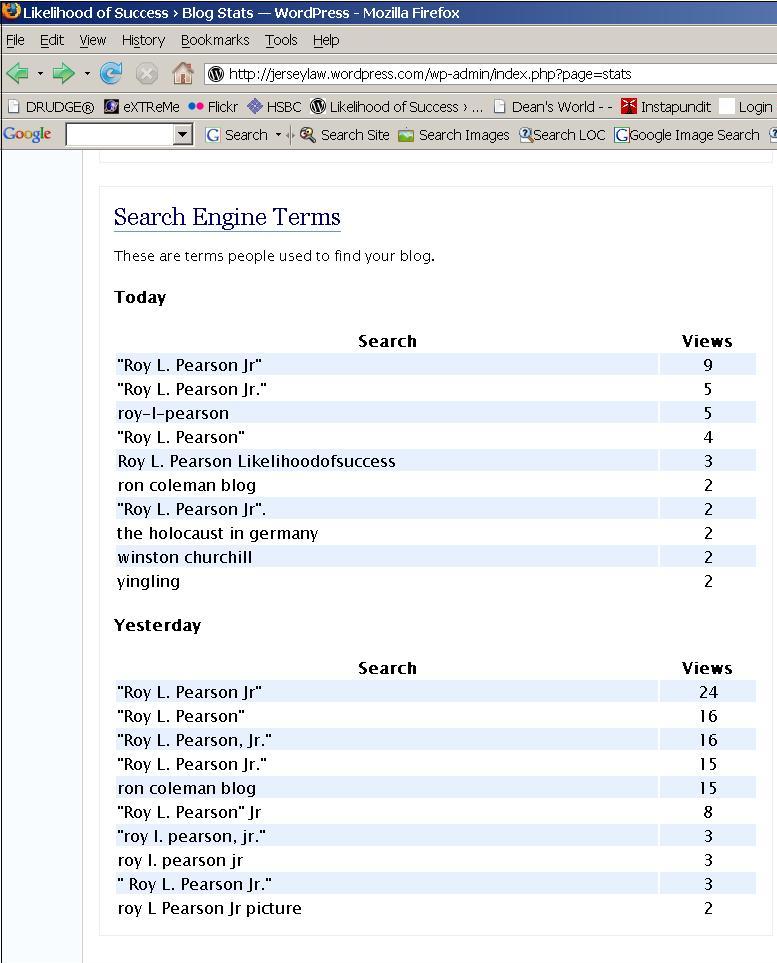
Roy L. Pearson Jr.I guess there’s a lot I still don’t understand about blogs. My WordPress blog stats tell me that far and away the number-one search term for surfers hitting this blog in the last two days is the phrase “Roy L. Pearson Jr.”

These are words that until this posting did not appear anywhere on this blog. And when I run the search myself, on Google, I don’t get Likelihood of Success.

Now it’s true that I did send the Roy L. Pearson story to Overlawyered, home of erstwhile blogger here David M. Nieporent, Esq., before they posted on it. I can document this (even though, it is also true, I was not credited). But is Google searching my Outlook files and working its way back to this blog? It’s not that bad. Not yet.

Can anyone explain this?

Posted in Blogophilia, Nuvo-Techno | 2 Comments »

Oh, Mickey, you’re so fine

Posted by Ron Coleman on May 3, 2007

Haven’t mentioned the brilliance of Mr. Kaus lately. Take a gander at this — it’s a long excerpt but you can handle it. I only regret the excessive use of boldface in the original, but he… he is Mickey. Now you read:

I’ve been trying to figure out why liberal bloggers are always attack the motives of neoliberals, and I think I’ve made some progress. It’s not that the bloggers are lazy punks who attack motives as a substitute for argument and need to constantly reassure each other of their own comparative righteousness because they feel guilty about their lockstep acquiesence in an agenda they themselves may have nagging qualms about. Not that at all! Rather, a) they are thinking of Joe Klein on a bad day, and b) there is a generation gap at work–not that they don’t remember the ’70s, when many of the problems of liberal orthodoxy became glaringly obvious, but that they don’t remember the decade before that.

Specifically, the young’uns seem to assume that in harping on the flaws of liberal orthodoxy aging boomer journalists are betraying their original liberal impulses. So there must be a reason for this disloyalty (careerism, desire to bolster credentials on the Washington party circuit, cash payments from Karl Rove, etc.) But many of us aging boomers aren’t betraying our original liberal principles. We are being faithful to our original New Left principles. What was the first critique of liberal orthodoxy to which I was exposed? The Port Huron Statement. Who was the original archenemy of ’60s radicals? Lyndon Johnson. Where can you find a thoroughly self-loathing indictment of the entire edifice of Great Society liberalism? In the Democratic Platform of 1972 (as Thomas Geoghegan pointed out in a famous New Republic essay, “Miami and the Seeds of Port Huron”). What constellation of doctrines are radical legal scholars–the “Crits”–trying to reveal as a fraud? “Liberal legalism.”

In short, orthodox liberals were the enemy of many who grew up in the ’60s. Still are! We aren’t selling out in attacking traditional Democrats and their interest group supporters. We loyally pursue the ideals of our youth! Though I’m happy to take Karl Rove’s money.

Bottom line: Neoliberals are old enough, or culturally deep enough, to be neo. Lefty punks mostly think they invented the whole thing and, pathetically, romanticize a never-never land of idealized, free-floating hippy (it stops there; never goes to Stalinism — no one does, after all) leftism. And, as Kaus says, anyone — anyone! — who isn’t with the plan, all the way and all the time, is in Rove’s pocket.

It’s not a basis for government or even political success — just ask Ned Lamont. Heck, it’s not even a basis for adulthood.

Posted in Politics and Poker | 2 Comments »

Likelihood of success

Posted by Ron Coleman on May 3, 2007

Peter Dutton passed this article along to an alumni mailing list on I’m on. It’s by an alumni interviewer about the almost tragic — but not quite — difference between getting to Harvard then, and now:

What kind of kid doesn’t get into Harvard? Well, there was the charming boy I interviewed with 1560 SATs. He did cancer research in the summer; played two instruments in three orchestras; and composed his own music. He redid the computer system for his student paper, loved to cook and was writing his own cookbook. One of his specialties was snapper poached in tea and served with noodle cake.

At his age, when I got hungry, I made myself peanut butter and jam on white bread and got into Harvard.

This is why I quit the alumni schools committee for my school: What’s the point? Virtually everyone who came to my office was absurdly qualified not just for admission but for tenure; I thought they should be interviewing me. All that happened was I fell in love with these absurd kids, wondered why exactly it was God had sent me to His alma mater, and then watched hardly any of them make it in.

The author of the article gets it, however. His four children did not apply to Harvard, just as my four will not apply to Princeton, though for somewhat different reasons. As he says,

But I’ve stopped feeling bad about the looming rejection. When my four were little, I used to hope a couple might go to Harvard. I pushed them, but by the end of middle school it was clear my twins, at least, were not made that way. They rebelled, and I had to learn to see who they were.I came to understand that my own focus on Harvard was a matter of not sophistication but narrowness. I grew up in an unworldly blue-collar environment. Getting perfect grades and attending an elite college was one of the few ways up I could see.

I could have written that myself, just about every word of it. Princeton was a complete hyperspace trip for me. It didn’t, however, deposit me in the stars, though it did do wonders for my frequent flyer miles. Frankly today I am skeptical entirely of the whole concept of four-year residential universities in general, and for some people — not necessarily the non-gifted — in particular.

A while ago I wrote a book called the Princeton Review Pre-Law Companion. The publisher hated it — they wanted me to write something like How to Get Into Harvard Law School, which I thought was idiotic; the question for most college students considering law school was whether law school made any sense at all, not where to go. (I actually said in the book that this was not true if you got into Yale, Harvard or Stanford’s law schools, which are simply markers for superachievement which almost anyone should accept regardless of the flavor of his ambition.)

My little book was popular with guidance counselors, but it went out of print fast. Someone else did write How to Get Into Harvard Law School, literally, and from what I can tell it’s still in print.

Posted in Americana | 5 Comments »

Plain talk on Obama

Posted by Ron Coleman on May 3, 2007

All right, I’ll admit it.

Look, Obama’s playing on being a minority group member. Well, let’s face it; he is. And let’s look at that minority, shall we?

We know what they’re all about, and so do they. Very well. Their culture openly, unabashedly celebrates who they really are. Substance abuse? Check. Violence? Infamous. Hostility to Anglo-Saxon values? Not a little — a lot. Just ask any one of ’em and stay the hell clear.

Sure, they’ve developed their own language, put English to their own unique rhythm — but so subversive! They claim to commemorate their cultural heritage but they do it all over our streets. These folks are not going back, and they’re not really assimilating.

Yes, damn it, I will admit it. I say to hell with another Irish president!

Posted in Americana, Jocularity, Politics and Poker | 14 Comments »